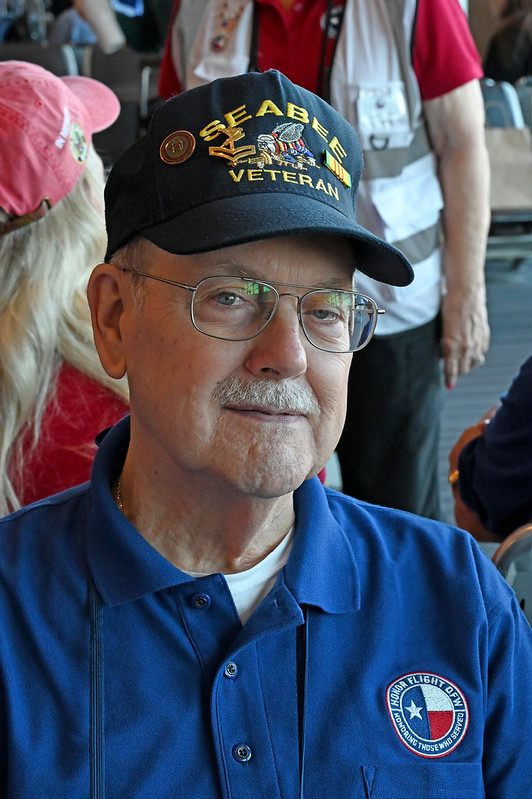
Blog of Seabee Tom

Seabee Tom Yant, CE2

Welcome to my Blog:
This is a repository of my random thoughts and philosophy, my ramblings. You are welcome to peruse the site and agree or not. I try to stay positive as that is how I have always tried to live my life. Sometimes it isn’t particularly easy, but we try. I have accumulated quite a few unpublished posts over the past year and a half or so and I’ll be posting them along in no particular order. So, bear with me and we’ll see how this goes.

Why blog this stuff? Why not? It gives me something to do and if someone along the way finds entertainment, something to ponder, or if it triggers a familiar memory in someone to revisit, so much the better.

By the way, if you are looking for my Seabee affiliation sites they’re right here: Seabees of North Central Oklahoma and Seabees of Collin County, Texas.
Posted 13 Nov 2025 © All Rights Reserved


Just Ramblin – Workshop

I was just recalling our first house that we owned jointly with a mortgage company and the VA in the early 70s. It was just a few months old and the yard was not improved. We had wanted to build a house to our plans out on Ridge Road, near Poteau, OK and we had purchased a beautiful one-acre lot out there. But the cost to build what we wanted turned out to be prohibitive. So, we bought a newly built house, sold the lot and used those funds to build a sorely needed workshop in the backyard.

We had a fair-sized utility closet and had it packed with stuff that would have been better stored in an out building. So, I found some good plans and contacted the builder that we had used to quote the house that we didn’t build. I figured this plan was a simple enough that he couldn’t go far wrong. He had a good reputation, but in our discussions with him about the house left us to believe he wasn’t very adept at reading blueprints. However, he really did a pretty good job. The building was 16-foot square and had a high roof sloping fore and aft, with skylights facing east.

I dug a trench and had electricity and a gas line installed. We had received a gas radiant heater that had been my grandmother’s, and I installed it in one corner adjacent to the double wide doors. In the opposite corner of that wall, I built-in a desk to setup as an ammo reloading bench.

All across the back wall I had built shelves for storage, and in the center of the floor a work bench island. Stringing a wire from the house for a Radio Shack intercom finished it off, save for painting.

Painting turned out to be the most frustrating part. I put on two coats of primer and two finish coats. Within 24 hours grasshoppers had eaten the paint off the edges down to the wood. I don’t recall how many times I had to touch up the paint before the siege was over.

The shed served well and I spent many hours there cobbling up a project or reloading 30-06 rifle cartridges for target practice. The gas heater kept the shop nice and warm, and I never missed a call to supper over the intercom.
Posted 3 Jan 2026 © All Rights Reserved Return to top


Just Ramblin’ – Constitutional

We had reached the age where we no longer had the energy to sustain our house and grounds of thirty-three years and so we moved on, into a senior living apartment building close to our daughter’s family where we have a nice small apartment sized for our current abilities and comfort. We have lots of neighbors and have quickly become acquainted with many of them. But it’s easy to spend too much sedentary time in the apartment which is so comfortable. Consequently, I often head outside in daylight hours and walk around the compound or down the street to shopping. But in the evenings, after dinner, I have started a routine of walking inside the building.

Walking the halls of our apartment building of an evening has become a constitutional for me. It gets me away and into a contemplative state of mind. Evenings in our building are normally very quiet. Our neighbors are sequestered for the night and the carpeted hallways are empty. The three floors of five hallways are interconnected into an irregular pentagon. And at each of the five corners is a nook. There are three elevators and six stairwells. So, one can walk continuously and climb stairs for exercise or relaxation. For me, it’s for both. It gets me out of my chair and moving, though I’m never in a hurry. It’s not altogether about exercise. There is a workout room for that and plenty of places to walk outside.

Normally I walk clockwise. Leaving our apartment on the first floor I set out toward the main entryway, past the mail room, snack area, sitting room and library, the wall of honor with veteran photos, and the dining room. I often encounter a vacant dining room, activity room, or theater with all lights aglow, and so have appointed myself as keeper of the lights and turn off those not needed for safety. A close neighbor takes issue with me and turns them back on when she sees me trying to conserve.  

I’m in no hurry on my walks and I take time to enjoy the artwork that line the halls. There is a good cross section of still-life, impressionism, and nature scenes. Additionally, all tenants have a lighted setback at their apartment and a small shelf to personalize their entryway. Many of these decorations are in a constant state of flux and add much interest to my rounds. The wall art is varied on all floors and very well done. There are tables and chairs strategically placed in open areas and nooks. Walking the hallways in the evening I hear the sounds of the entertainment being enjoyed in several of the apartments.

 On the second floor I pass the activity room on one side and the theater on the other containing a big screen, chairs and a popcorn machine. At the end of the room is a pool table with balls all set for the next player to break.  A little further down the hall is the exercise room with treadmills and stationary cycles where I stop to lift weights with a couple of short repetitions and a few minutes on the treadmill. Continuing on, I pass a nook with a table often spread with a puzzle a resident has started. As I continue down the hallway I arrive and spend time in the second-floor library where each night I read a few pages of a book as a serial. This is always an anticipated break.

Climbing stairs to the third floor I continue my walk and occasionally there are strains of melancholy piano music coming from a certain apartment and I pause to listen. In the north corner is a nook with a table and chairs, and an arm chair in the corner by the windows. I’m in a habit of stopping there, sitting by the window for a few minutes looking out over rooftops and the tree line beyond. It’s peaceful there and I often find inspiration to write a few lines. Continuing down the hallway, I arrive at a nook called Treasures with tables set with goods for sale. Goods are donated by the residents which proceeds go to fund activities. I continue around the floor and pass a nook with another puzzle laid out and often stop to visit with the puzzler when we meet before continuing around to the stairwell where I descend to the first floor for a cup of coffee before retiring. I have then walked the circuit on all three floors and climbed and descended the stairway nearest our apartment.

Tonight, the fireplace is warming the first floor sitting room and as I turn off the excess lights and television in the empty space it seems that the fireplace should also be extinguished, but it is so pleasant I just want to sit and enjoy it a while before returning to our apartment.
Posted 2 Jan 2026 © All Rights Reserved Return to top


Just Ramblin’ – Pondering the Ponca City I Remember

I get to reminiscing about my hometown quite often. About how it was when I was young. I will point out places that are standout memories for me, but there were many more businesses and domiciles along the way that just can’t be included. Bear with me if I still get too meticulous while reminiscing, or skip ahead.

Ponca City, Oklahoma was founded overnight with the Cherokee Strip land run in September of 1893 and named after the Ponca tribe whose land was located five miles south of the township. The word “Ponca” conjures the vision of the tribe of our native American brothers and sisters, and school mates to those of us living in and around Ponca City. I was born in 1944 and reared in Ponca City, Oklahoma at a time when it was still common to find our native American Poncas sitting and moving around town wrapped in a robe, or blanket.

The Ponca tribe has the distinction of having been led to the land between the banks of the Arkansas and Salt Fork Rivers in Oklahoma in 1879 by none other than Chief Standing Bear under the duress of the federal government. Chief Standing Bear and his family and followers found the climate intolerable after he lost his son and, without permission, returned to the banks of the Niobrara River in Nebraska to bury his son and remain. They left behind a good portion of the tribe in Oklahoma under Principal Chief White Eagle. Standing Bear went on to make history when he was charged by the government and, going to trial in federal court in Omaha, successfully argued that he was a man and that native Americans were “persons within the meaning of the law” with the right of habeas corpus.

My first memories of the town begin with our little house at 115 N. Ash Street, just a half block north of Grand Ave. One of my earliest memories is that of riding a bus to downtown with my mother. I must have been very young because I don’t recall whether my younger brother, Bob, was with us. It was just a short distance straight down Grand Avenue about eight or ten short blocks. My memory was so vague that I couldn’t recall whether it was valid until I read the obituary of Mrs. Myrtle Sidles who had lived across the street from us at the time. It turned out that her husband had bought and operated the buses in Ponca until his death at which time Mrs. Sidles continued to operate them for a while before selling the company.

About the time I was becoming school age I attended a class in Mrs. Sidles home, in the basement if I recall, where she taught elocution. Many kids of my age at that time attended her classes including my wife, Linda, although we didn’t know each other at that time.

One Sunday noon my family and I were at the dining table eating our dinner when an explosion shook our house. We jumped up and went out the front door and found smoke coming out of Mrs. Sidles house. There had been an explosion in her basement. Her obituary stated that her house burned in 1953. I was nine years old.

Mrs. Sidles became pretty much of a Ponca City institution when she wrote and produced a play about the beginnings of Ponca City and made a Cherokee Strip parade float featuring a living portrayal of the bronze Pioneer Woman statue that stands at the intersection of 14th Street and Highland Ave. This float was a fixture in the parade from 1939 until 1968, according to her obituary. She also owned a native American apparel store downtown where I purchased a pair of moccasins as a teenager.

The Pioneer Woman statue, mentioned above, was a product of sculptor Bryant Baker, dedicated in 1930, and was the inspiration of E.W. Marland, according to the Oklahoma Historical Society.  Ernest Whitworth Marland was a lawyer, congressman, oil magnate, philanthropist, and governor of the State of Oklahoma. He leased land, 10,000 acres according to the Historical Society, from the 101 Ranch southwest of Ponca City for oil exploration and struck oil on Ponca tribal land of Willie Cries-for-War. This strike and others in the region led to the establishment of Marland Oil Company, later to become Continental Oil Company, now CONOCO.

Marland eventually went bankrupt through his extravagant lifestyle spending and borrowing from New York bankers. He had made many donations to the city for buildings, parks, etc., with the Pioneer Woman statue among them. He had built his own “Grand Home” on east Grand Avenue, and an elaborate “Palace on the Prairie” home on North 14th Street in Ponca City which now belongs to the city and is an historical site.

Marland wasn’t the only contributor to Ponca’s growth. Lew Wentz and William H. McFadden were also highly invested in the oil business as were local philanthropist. Lew Wentz never married and lived in a room of the Arcade Hotel at the corner of Grand Avenue and 1st Street. Ponca City benefitted greatly with a beautiful high school, hospital, airport, parks, and Wentz Camp with a public pool and lakeside golf course through the philanthropy of these three and others; including Andrew Carnegie who funded the building of the beautiful library.

“The Ponca City Library’s brick and terra cotta exterior houses the Matzene Art Collection, a unique and extensive collection of artwork consisting of both Oriental and Western art. These paintings and statues are on display year-round throughout the building. Richard Gordon Matzene, a well-known photographer, art dealer, and world traveler donated a substantial part of his collection of American Western art and Oriental art to the library in the 1950s.”1

Much architecture in Ponca City is Mission/Spanish Colonial Style, from the City Hall, the Royalty Building, Santa Fe and Rock Island Depots, and many other buildings and dwellings. At that time, the most prominent feature of downtown was the Ponca City Milling Co. grain elevator, painted all white with a large Robin Hood flour logo painted on the sides, just a block south of Grand Avenue along the railroad tracks and just north of the Santa Fe depot.

A half mile south of Grand Ave. is the now Phillips 66 oil refinery. Prior to about 1970 there were two refineries. Conoco and its tank farm and offices was on the west side of the railroad and Cities Service2 refinery on the east side. Conoco eventually took over the Cities Service refinery, around 1968. Then, in 2002, Phillips bought out Conoco and it became ConocoPhillips. Now it is just Phillips 66, an extension of the Philips 66 refinery in Bartlesville, 70 miles east. About 1960 Conoco had a sign posted at the entrance to the city stating that they had 3000 employees. I knew a lot of friends whose fathers worked at either Cities Service or Conoco. Several of my classmates went to work at Conoco and Linda, my wife, went to work there as a keypunch operator right out of high school. Families of Conoco had the benefits of a nice indoor gym and swimming pool, which the rest of us town kids envied.

But there were public pools around town. In our neighborhood, Lincoln elementary had a pool, and there was Bogan, now Ambuc’s, pool on south 7th street, and Wentz Camp pool at the northeast side of the Lake Ponca. It is a beautiful Olympic size pool overlooking the lake and golf course. At Wentz Camp is a tall tower built to resemble a golf ball on top of a tee. Inside is a winding staircase to the top where you can view the entire area. I once counted 165 steps to the top.

In those days the streets in town were all paved with brick and always rough. In the late 40’s and very early 50’s once in a while a water truck would go slowly down the street spraying a flat fan of water, followed by a couple of men with push brooms to clean the streets. They swept away our little dams built at the curb to back up rain water for our toy boats.

Grand Avenue, which runs east and west through downtown, at that time extended from Ash Street east to 14th Street. At the west end of Grand at Ash Street was a two-story Victorian farmhouse built in 1905 and owned by the Hampton family during my time. In 1963 the house was moved and repositioned facing Grand Ave. as Grand was extended westward.

From Ash Street going east toward downtown the cross streets are all named mostly for trees. Except Lake Street, the next street after Ash, and Union farther on. After Lake came Palm, Osage, Elm, Oak, & Pine Streets. Union Street crossed on the west side of the railroad tracks, then the streets were numbered through downtown, 1st through 14th.

From Palm Street, Grand Avenue was mostly commercial running east to 7th Street. Between Palm and Osage on the north side was then the WBBZ radio station, a fire station on the corner, and an osteopathic hospital on the south side of Grand.

Across Osage on the north side was a gas station where we kids aired our bicycle tires. Next door, east, was an appliance store we called Luckies, owned by Mr. Luckinbill, where dad bought our first TV and we kids hauled off large boxes to play. I believe I remember an apartment building next and E.M. Trout funeral home on the corner of Elm Street. The funeral home is a beautiful three-story white frame house owned at the time by Ernest M. Trout, Sr. and his sons where they provided funeral services and, at that time, ambulance service.

Across Elm going east was the West Grand Market which was our convenience store and favorite place to buy ice cold Black Diamond watermelons floating in a tank of refrigerated water. Across the street to the south was a vacant lot where Pulliam’s market sold water melons in season also. East of West Grand Market was a red brick apartment building, and then a blonde brick building with two businesses. On the west side of the building was a beauty shop, and on the east side a barbershop. The owners of the building were Vern and Queenie Alvord who were our barbers, a jovial couple with a residence at the back of the building. The next building east was the Norris Motor Co. It too was a blonde brick structure that matched the barbershop, and it was an auto repair garage.

Across Oak Street to the east was the Safeway food store with parking on both sides. And to its east was a farm store and hatchery. It was a structure with a green painted wooded façade. The door was always open and starter plants were displayed outside. Inside was feed and all kinds of farm needs including chicks, which we always had to stop to see. The store was not well lit inside and spilled the aroma of plants, soil, and fertilizer out to the passersby.

Farther east was a building with two businesses on the ground floor. The first was a yarn and needle-work shop, Cos-Lin Mart, where wife, Linda, bought enough yarn to take with her, when we went to Australia, to knit an afghan nearly the size of a bedspread. The shop was operated by a couple of elderly ladies and at the time was the place in Ponca to buy such supplies. My mother enjoyed embroidery and I’m sure she bought her supplies there. Next door, east, in the building was a Rexall drug store owned by Alvin Becker. My parents frequented this pharmacy and we were regulars at the soda fountain while we lived on this side of town. The pharmacy was on the corner of Pine Street. Just south, across Grand Ave., was a competing pharmacy, Sander’s Drug.

Going south on Pine Street was the Chevrolet dealership, the Ponca City Ice plant, and at the end of the street, across South Avenue was Conoco offices, research and refinery.

Back on Grand and across Pine Street to the east was a red brick building that housed Glenn Paris Furniture. Behind the furniture store and across the alley on Pine Street was a yellow painted wood framed planing mill that always interested me. I supposed they sized lumber, and I still wish I had gone in to see it done. Back to Grand Ave. there were several brick buildings along the north side of the street that were conjoined and I don’t recall the businesses with the exception of a small tavern set in the middle of the block. Just across Grand to the south was the black owned and operated theater, the Roxy.

Union Street was the next street east and it parallels the railroad track. Across the track to the east was Long-Bell Lumber Company at that time. It burned to the ground in 1971. Across Grand Ave. to the south was Auto Electric Co., an automotive repair shop. East of Long-Bell was Edwards Auto dealership that sold DeSoto and Plymouths, if I recall correctly. Then on the corner of First Street was Ponca Hardware. Across Grand Ave. south of the hardware store was the Arcade Hotel. The Arcade was of Mission Revival architecture with white stucco exterior and red tiled roof. It was sold and razed in the 1970’s. A terrible loss to Ponca City, in my opinion.

Just around the corner north of Grand Ave. was a canvas covered stairway down to a basement tavern, called the Penny Bar. I was never in it but it was said to have a bar top covered with pennies.

Directly across the street was the Western Union office where my father was the manager until it closed in the early 1970’s.  Next door north was a Doctor Jones’ office, and Jim Chittum’s gun shop on the north at the alley. Back across First Street north of the alley was Clifford McVay’s pawn shop called U.S. Loan and Surplus, and in the 70’s his son, Gary, expanded with a clothing store. I always enjoyed going in to look at model airplanes, guns, and war surplus items. In the 70’s I bought several new Pendleton blankets for gifts. According to my father, Cliff had been an Alaska bush pilot. North of McVay’s was a café that fascinated me because they served calves brains, though I never had the nerve to try them. Next, on the corner, was a beauty school.

Across Cleveland Ave to the north was a market, Quality Market if I recall correctly, later to become a Sears store. Regressing, back west across the railroad tracks was Midwest Creamery on the corner of Union.  Then farther north on Union Street, at the corner of Highland was a Sinclair gasoline service station before that intersection was converted into a railroad underpass. Then just north on Union, near the corner of Summit, was our family’s self-service laundry, we named Meter-Matic, then later Sooner Laundry.

East of Union across the tracks at First and Highland was an empty lot where in the summer were held tent revivals. Across First Street, east, was built a Humpty Dumpty supermarket.

Back south on First Street, at Broadway was a Quonset hut building with a brick façade that was the Rambler automotive dealership. Then farther south, at Chestnut, was a Paul A. Long & Son, gasoline distribution office. At 209 North 1st was the Oldsmobile dealership, and on the corner at Cleveland was Prather Paint and Paper.

Around the corner on the east end of the building were three small shops, and one of those was a maternity shop owned by Mrs. Riesen, the wife of a realtor dad worked for part-time. Across the alley, east, was Anderson Shoe store, and north of the shoe store was a green trolly car turned into a diner that sold famously thick malts.

Across 2nd Street east of the shoe store was the bus depot, where I left to join the Navy and returned from recruit training. South of the shoe store, across Cleveland, was the Lessert Funeral Home. On the southeast corner was the Jens-Marie Hotel, a six-story red brick structure that was a half block long with 125 guest rooms, including “12 luxurious suites, each in a different architectural style of furnishings and decorations,” according to Ponca City Main Street. It was razed in 1978. It was a beautiful old building on the inside and contained a restaurant and meeting facilities. The Lions Club met there and I’m sure there were others.

East on Cleveland at the northwest corner of 3rd Street was the Ponca City News office with the press in the basement.

Farther east, at 4th & Cleveland, on the northwest corner was the whitewashed building of the Firestone Tire store.

At the northeast corner was the First Presbyterian Church, a stately building of “colonial design… of grey brick and Carthage stone trim”3 with front steps and pillars facing 4th St., and a domed nave. I suppose today it would be called neo-classical architecture. On the west inside of the nave was a raised stage with the pulpit in the center and high back chairs toward the back of the stage facing forward. Behind the chairs was a wall with stairs at each side of the stage leading up to a large choir loft stair stepped up with the pipe organ at bottom center. The organ pipes were arranged above and behind the choir. The pews were arranged in an arc around the curved stage with three aisle giving access. There were large stained-glass windows on both north and south sides. The south side, if I remember correctly, had the scene of Christ praying in the Garden of Gethsemane. This window was saved and placed in a frame, backlit, and placed in a small chapel in the basement of the new building dedicated in 1957 on the corner of 14th at Grand Avenue when I was a 13 years-old communicant. The small chapel was furnished with pews and articles from the old building. The vacant lot to the north was used for children’s play and summer revival services.

Just east is the First Chistian Church (Disciples of Christ). It is a large yellow brick building with a bell tower topped with a dome. The First Chistian Church bought the Presbyterian corner and turned it into a parking lot.

Back to the intersection of Grand at 1st, going south down 1st Street was Farha Wholesale Company owned by Tannel “Tiny” Farha. (I mention this because my father leased our laundry building from Tiny.) Oklahoma Street intersected 1st and dead-ended at the Santa Fe Depot adjacent to the “Robin Hood” grain elevator. On farther down 1st Street was the Coca Cola Bottling Company, Nickles Machine Co., owned by the family of the late U.S. Senator, Don Nickles, a Studebaker dealership, and at the end of the street, across South Avenue, was the main gate to Cities Service Refinery.

Again, back at Grand Avenue, the Poncan theater is on the south side with, at that time, a wide, three sided, angled marquee across the front of the building that covered most of the Poncan façade. On either side of the theater were retail shops in the same building. This marquee had replaced the original, square marquee, that had dated from 1927. On the west was the Cozy Barber Shop, and on the east a retail store and a tiny shoe shine shop. The beautiful interior décor of the theater is reminiscent of an Italian villa. However, at the time of my youth that scenery was all covered over with long drapes. In its heyday the theater was host to all the vaudeville showmen of the era as well as movies and, as of 1985, is listed on the National Register of Historic Buildings.

Across the street, north, was Dodge Drug, Western Auto, Phil’s Cafeteria, and SH Kress 5&10. On down the block was Hickman Hardware, and Smitty’s Men’s Wear.

Herman Smith, Smitty, a Lt. Col. in the USAF and was mayor of Ponca, 1954-56. He had two sons, John and Truman. Truman, was a B-17 pilot over Europe during WWII and attained the rank of Lt. Col. in the 8th Air Force. Smitty, offered to recommend me to a military academy when I was hardly old enough to know what a military academy was. My grades were never good enough to even broach the subject to him again. By the way, his son, Truman, wrote a book about his experience flying B-17 over Europe during WWII entitled The Wrong Stuff.

On the southwest corner of Grand at 2nd was the 1st National Bank & Trust. Diagonally across the intersection on the northeast corner was Cuzalina Drug store. TJ Cuzalina wrote a very popular weekly article in the Ponca City News called Poppin’ Off on every subject imaginable. He has been credited with originating the slogan “I Like Ike.” At the east end of that block, on the corner of 3rd, was the Community Building. It contained a menswear store and barbershop on the ground floor and offices, including doctors, on the upper three floors.

Across Grand, to the southwest corner, was the Masonic Building which consisted of six floors. The first floor held the Security Bank. The lobby and hallways contained a lot of marble being decorated in an art deco motif, if I recall correctly. The upper floors contained offices including doctor and dental offices. At the south end of the building’s first floor, on the alley, was the Western Union office until the early 1950’s when it was relocated to the 100 block of North 1st. At the intersection of Grand at 3rd and annual Christmas tree was erected at the center of the intersection.

In the block between 3rd and 4th on the south side were JC Penney and CR Anthony, next door to each other. CR Anthony had wires strung between the points of sale around the store and the upstairs business office. All money was put into a canister with the sales slip and then shot up along the wire to get change back and paid sales receipt. Around the corner on 4th and down the block was a restaurant called the Pioneer Grill which was a very popular place. However, the only time I was in it was early one morning to meet the Navy recruiter before boarding a bus for a four-year hitch.

Back across Grand, on the corner was Ken’s Café, and to the north, on 4th at the alley was another little café called the Coffee Cup. They had great hamburgers that couldn’t fill me up when I was a little fellow. Across the alley, north, was the Howe Building, owned by Johnny Howe, and housed Howe Bakery where they made loaves of bread and pastries. Their bread slicing machine was near the front window so you could stand on the sidewalk and watch them slice and wrap fresh loaves of bread. The Howe’s were Presbyterians and brought hot rolls and donuts to the church on Sunday coffee and for dinners. Just north of the Howe Building was a Kroger grocery store and the IOOF, ODD Fellows, Building adjacent to the north.

Across 4th to the east was Brown Optical and Faye’s Fashions. The optician was Dewell Brown, a neighbor of ours for a few years, whose oldest son became an optician also, and his daughter married an optician.

Fay Paisley Cook, of Faye’s Fashions, was a member of the Presbyterian church, and my parents knew Fay and husband O.Z. well. Fay knew my mother was a seamstress and employed her part time for a while before our lives took a turn when we moved and opened a business of our own, the laundry, mentioned earlier. O.Z. died in 1956, at the age of 59, and Fay never remarried, but threw herself into her business and community service. After O.Z. passed, I don’t recall seeing her wear anything but black. She passed in 1997 and donated her body to science. She was always thinking of others.

Across the alley, south, was the Royalty Building. Always painted white, the first floor facing Grand, was the upscale ladies clothing store, Frohlich’s. Adjacent to it was Southwestern Stationery & Office Supply. On this side also was JG Paris Furniture and the Montgomery Ward store. On the corner of 5th was Bill and Jean’s Café, now operating as Grand Cafe.

On the south side of Grand, on the corner of 4th, is the U.S. Post Office. It was, and is, a stately granite building which also housed the Selective Service Office, among others. There was a kiosk inside where a blind man operated a little newsstand and candy counter. To the east was an insurance agency, and on the corner of 5th was the Goodyear Tire store. South of Goodyear, across the alley at 5th and Central was an automotive dealership that sold Lincoln, Mercury, and Dodges.

Across 5th, to the east, was/is the Municipal Building and fire station. These facilities cover the entire block, 5th to 6th, and Grand to Central. The municipal building, at that time, included an auditorium where Ponca’s Little Theater performed. In front of the building is a war memorial and fountain. The fountain has two concentric circular basins with a low curb around the outer and jets of water in the center shooting skyward with color lights playing on the water. The fountain used to have a higher curb around the outer ring with a rim wide enough to sit on, or in our case as youngsters, walk around.  The inner basin was a circular rock wall that contained the water jets and lights. The water shot up partially filling the rock basin before spilling into the outer basin. The old fountain had to be repaired so the city replaced it with the more modern design.

On the northwest corner of the property is a statue of oil man, former congressman and governor E.W. Marland sitting looking up Grand Avenue. On the northeast corner was an early day fountain apparently designed to water horses and dogs. It has since been replaced by a statue of oil man and philanthropist Lew Wentz, and the fountain moved to a veterans’ memorial recently built on the northwest corner of 4th & Grand.

Across the street, north, of the Municipal Building is the library that now takes the entire southern half of that block. The first library on the site was a Carnegie library that was subsequently replaced through a grant from the Public Works Administration, according to library documents. In the 1950’s the library an extensive collection of Asian art on the walls for the public to enjoy, as mentioned earlier. In the basement was a collection of Ponca Indian and 101 Ranch memorabilia. The library building was situated in about the center of the south half of the block between 5th and 6th. On the southwest corner was a Conoco service station. The service station is now gone and the library has been expanded using the original architecture

On the block east of the Municipal Building is the yellow brick structure of the Junior High School which takes the entire block. Across Grand, to the north, was/is the red brick office of Ponca City Board of Education. When I was schooled there, there were some classrooms in the Board of Education Building and the buildings were connected by a tunnel under Grand Avenue for the students to get to class.

Farther east, at 10th Street, begins a long block on the south side that extends to 14th St. The west end of the block is the E.W. Marland Grand Home. Its property covers about the equivalent of two blocks and the house faces north toward what had once been his polo grounds, now a residential neighborhood. It is a sprawling house with a swimming pool in the basement. The city took it over and it is now a museum with the Ponca Indian memorabilia from the library.

Farther east on Grand at the northeast corner of 13 was/is Grace Episcopal Church, and on the property just east, on 14th was a service station. The station is now gone and the church has expanded on its property.

Across Grand Avenue, to the south, is a stone building that was Higdon Florist. Its sunroom on the east side was always full of flowers and a joy to view in passing.

On the northeast corner of Grand at 14th is the Presbyterian Church on an eight-acre lot. Dedicated in 1956, it has long, high nave supported by wooden arches with a large stained-glass window on the east end and a balcony on the west. From each end of the nave are hallways lined with rooms or offices running north, and those hallways are connected by another east-west hallway with offices and restrooms along it on the north side. In the center of the structure is a grassed courtyard and playground. The fellowship hall with a kitchen and performance stage is on the northside and, at the west end of the Fellowship Hall, a chapel. There is a basement with classrooms and a small chapel that was moved from the previous building. A second story is located over the east hallway and it contains a recreation room, kitchen, and classrooms. Sadly, the building has been put on the market and the remaining small congregation abandoned it in 2025 and moved in with the Methodist Church at 200 S. 6th.

About a half mile north, at the northeast corner of Highland Avenue, is the bronze statue of The Pioneer Woman that was sculpted by Bryant Baker and dedicated in 1930. The statue faces southwest toward town and is surrounded by a park and circular drive. Behind the statue is a diagonal street called Monument Road, that leads to the Marland Estate. E.W. Maryland built this extravagant house finishing it just in time for the Great Depression that left him bankrupt.

From the Pioneer Woman statue east is Lake Road leading to both Lake Ponca and Kaw Lake. Both are man-made lakes. Lake Ponca was formed by damming Turkey Creek, and Kaw by damming the Arkansas river and installing a hydroelectric power plant.

From the Pioneer Woman going west about 700 feet is a Jewish Temple Emanuel Synagogue. Dedicated in 1964, it wasn’t there when I left home, I mention it here because it has an interesting history dating back to the land run. Its congregation dwindled subsequent to the removal of CONOCO office employees who were transferred out of Ponca City, according to the Institute of Southern Jewish Life, https://www.isjl.org/. It’s my opinion that the First Presbyterian Church lost the bulk of their members for the same reason.

In the 1950’s the northern most avenue, east to west, was Hartford. There was a housing addition north of Hartford, but the next east-west road was Prospect and it bisected wheat fields westward across the north end of the airport to Waverly Street. Now the runways have been extended northward and the new northernmost east-west through-street is Hubbard Road, another mile north.

At the intersection of Hartford and 14th was/is the Ponca City Hospital. Although in the 50’s it was much smaller than it is today. With a stucco siding and red tile roof it had a Spanish Mission look about it. I have retained a canceled check in the amount of $25 dated a day or so after my birth and made out to the order of the hospital with a memo ‘For Tom.’

These are some of the places that standout in my memory, but I’m filled with memories of many other stores and sites in town and along Grand Avenue. My home in memory.
Posted 1 Jan 2026 © All Rights Reserved


Just Ramblin’ – Cruising the New Car Showrooms

By 1957 I was 13 years old and beginning to get really interested in cars. Dad’s office was in downtown Ponca City on First St. just north of Grand Ave. and I spent a lot of time there, especially after school. Dad was the manager of the Western Union office and his side jobs were real estate and owner of a laundromat. At that time all the car dealers had showrooms and not much inventory, and dad’s WU office was just within blocks of most of them at that time.

On the next block north on First St. was the Oldsmobile showroom, and a block and a half farther north was the Rambler showroom. Also, on south First was a Studebaker dealer. Just a half block west of First on Grand Ave. was the Dodge and Desoto showroom, as I recall, and they also sold Plymouth and Valiant. Across the railroad track and a block west and a block south was the Pontiac and Cadillac dealer, next door to the Chevrolet dealership. Then one block east of First St. and one block south was the Ford and Edsel dealership.  Five blocks east of First and a block south was a Lincoln & Mercury dealer who also sold Comets.  There was also a Buick dealer fourteen blocks east and 4 blocks north. I didn’t get out there very often, but my music teacher came to school driving a new 1959 Buick that I fell in love with. Buick came out with three models that year, namely the LeSabre, Invicta, and Electra. The three looked very much alike with slanted tail fins and headlights set on a slant. I would still like to have one of those.

The dealerships that were in close proximity of dad’s office at 105 N. 1st St. gave me ample opportunity to shop new models, not that I had any inclination to buy one on my $3 a week allowance. I made the rounds often during those years until I turned 18 and left for college. One of my favorite places to go was the Ford dealership to ogle the Thunderbirds and to the Chevy dealer to drool on the Corvettes, which often sat outside on the corner. I also couldn’t pass the Oldsmobile and Rambler dealerships without wandering through. These two were on my way as I walked to my family’s laundromat after school. This walk included a stop at dad’s office and the drug store around the corner for a “short” 5₵ Coke. This was the era of distinctive style changes year to year now with fins and pushbutton gearshift on the dashboard on Plymouths and in the middle of the steering wheel on the Edsel. The dealers had so small an inventory that when a car sold out of the showroom, what would be the features on the next one displayed? It was so exciting to anticipate and see what was next to come. It was a good time to be a kid in love with cars.
Posted 30 Dec 2025 © All Rights Reserved


Just Ramblin’ – Short Road Trips

We, Linda and I, have always liked to take short trips just to get out of town. Where we grew up, in Ponca City, Oklahoma we could drive 12 miles in almost any direction and come to a town. Since before we were married we would make the drive from Ponca west to Tonkawa then north to Blackwell, back east to near Kildare, then back south to Ponca. Sometime we would take the Blackwell shortcut straight diagonally to Blackwell, then back one of the other routes. This made for a nice leisurely afternoon drive with stops for Coke or ice cream. Ponca City has been known for its oil industry where Marland Oil became CONOCO, became Phillips 66.

Once married we found ourselves in outback Australia on what is called the Northwest Cape. There was a paved road from the end of the landmass to Vlamingh Head Lighthouse on the point. The road leading to the cape was dirt for 90 miles, in late 1960’s, then was paved another 700 miles south to Perth, WA. The cape has the Indian Ocean on the west and Exmouth Gulf on the east. The gulf had served as a submarine base during WWII and there are still bunkers facing the sea.

On return to the USA, we lived in Poteau located in southeast Oklahoma for over eight years, and our weekend road trips were drives to Fort Smith, Arkansas and/or to the Ouachita National Forest. In much of Oklahoma the roads follow section lines in a grid. In that mountainous area the roads follow the terrain. We always enjoyed a trip across the top of Winding Stair and Rich Mountains from Talihina, along Oklahoma Highway 1, into Mena, Arkansas. It is a beautiful scenic drive labeled Talimena Scenic Byway.

We eventually wound up in Payne County, Oklahoma where we lived for 41 years in Stillwater. Here again the roads pretty well follow section lines. Twelve miles north and twelve west is Perry. Then twelve south and twelve east and we were home again, after a nice ride and refreshments. Perry is a quiet, rural, little town with a world class manufacturer, Toro Company, previously known as Ditch Witch and Charles Machine Works.

Cushing, OK was another go-to drive. We often ate supper a little Lebanese restaurant there. Cushing is nine miles south and sixteen east of Stillwater and is known as the “pipeline capital of the world.” Oil from all over the country is piped into Cushing, stored, then piped downstream to Houston for refining. Cushing has had refineries in the past, and a new refinery is currently being built there. I enjoyed swinging out by the airport too. Cushing has a jump school, and most weekends skydivers are in the air.

Those days were then. Today we have grown older and, out of necessity, have moved to a suburb of Dallas. Allen, TX is between Plano and McKinney and is all urban and growing exponentially. Twelve miles will hardly get us to a rural scene, and that by-way-of busy streets, turnpikes and freeways. So far, our drives have been to Fannin and Red River Counties, where my parents were reared, to visit cemeteries. We enjoy going to those rural areas more easily accessed from the northeast metro, where we live. I’m looking forward to a trip one day southeast to Terrell to fly an airplane I’ve had my eye on, then to Tyler to tour the rose gardens. We will find trips to take, but none of them will be as short and casual as we have been used to. The memories of drives past are still good and cherished.
Posted 29 Dec 2025 © All Rights Reserved Return to top


Just Ramblin’ – Peter Marshall, D.D.

I’ve been listening to Dr. Peter Marshall sermons, which are just audio recordings on YouTube. He was a Scottish Presbyterian minister of fame when I was just a little fellow and I didn’t know much about him other than what I heard from the grownups that he was a famous preacher. He also served as Chaplin to the U.S. Senate for a couple of years before his untimely death. But listening to his sermons has brought back a memory.

My family spent one Sunday afternoon in the home of Dr. Charlie W Shedd who was our pastor in Ponca City, OK at the time. My brother and I went off with their kids, Philip and Karen, while my parents and the Shedds listened to a 16 RPM recording of someone preaching. It turns out that there were such recordings of Peter Marshall at that time and now I feel like I know who it was that had my folks and Charlie and Martha Shedd gathered around the record player that afternoon. I believe those were the only 16 RPM records that I have ever seen and it made a deep impression on me. They were very large discs and played a long time. So, now 70 years later I know what we were doing there that Sunday afternoon.
Posted 28 Dec 2025 © All Rights Reserved Return to top


Just Ramblin’ – Grandma’s Kitchen

Kitchen sink
Facing west toward
Cotton fields
And water buckets
On counter end,
One for cooking
And one for dipping
A drink of cool
Well water.

Across entryway
A pantry lined
With shelves of
Home canning
And airtights
From store.
Sad irons on shelf
And on floor
Crates of soda
Variety galore
For grandkids.

Down the wall a
Door to sleeping
Porch stands open.
On east wall
A table with a yellow
Art deco radio
Playing  market
Report. A cupboard
beside and a door
to hallway and
one to dining
room.

Gas range
on south wall
and square table
in kitchen
center with a
glass full of
spoons await a
hearty breakfast
at break of day.

Posted 27 Dec 2025 © All Rights Reserved Return to top


Just Ramblin’ – Comin’ in the Side Door

At grandmother’s farm house in north Texas, on the west side, was a little square porch built off the kitchen that held a shelf for granddad’s shaving basin, a mirror and his razor. It was screened all around and had a screen door to the outside on the south side. This door led out to a well, and beyond was a cotton field. Back just inside the kitchen on the right of the door was a counter that held the sink with water taps from a cistern and pump out back, and on the end of the counter by the door were two buckets of well water. The bucket on the right held a dipper for anyone to get a drink, and the bucket on the left held a light weight sauce pan for dipping water to be used for cooking. As a youngster in the 1950’s this was a curiosity because at home our water came from a tap. At the farm, every time I came in or out through that entrance I had to stop and get a drink from the dipper. But every now and then I had to steal a drink from the sauce pan, though the water was exactly the same. The novelty being when the partially filled sauce pan touched the side of the bucket it rang with a boy-oy-oing. Today, every time I bump a partially filled saucepan it takes me back to grandmother’s kitchen and the memories made there.
Posted 26 Dec 2025 © All Rights Reserved Return to top


Just Ramblin’ – Christmas

Here it is, Christmas day again and we just got home from midnight Mass. It’s been a tradition for me and my family since I was old enough to stay up that late and not having to worry about interfering with Santa Claus. Back then I was Presbyterian and attended with mom and dad, and brother Bob. Now, they are all gone and it’s with my daughter’s family and we are now Episcopalians. Of course, the Presbys don’t call it Mass, but in Ponca City, OK it was the Christmas Eve Candlelight Service. Be that as it may, when at midnight Mass I bring thoughts of mom and dad with me as if they are there. Brother Bob had married into the Jehovah’s Witness fellowship and had eschewed Christmas since. But I drag him in with me in spirit and since his passing this year I doubt if he is objecting.

Thoughts drift back to the Ponca City Presbyterian Church and Arthur C. Young, D.D, the pastor. The church was built in the early 50’s and dedicated in 1955 when so much of the population went to mainstream churches and this new building was soon at 100% utilization when Art Young became the pastor. The nave is long and seats approximately 400 plus individuals. Christmas Eve filled it up to overflowing and folding chairs were brought in. The service always included a trip to the front to place white gifts in a crèche in support of the Cameron House in San Francisco. The service included many familiar Christmas carols, a sermon, choir performances, and candlelight with the singing of Silent Night, followed by a procession of the entire congregation out the front door into the cold for the benediction. I never understood the reason for the exit for the benediction, but that’s the way it was in the 1960’s.

Last night’s Episcopal Mass included a touching reminder of years past with the singing of carols by candlelight while singing Silent Night with family, family spirits, friends, and the grandkids serving as acolytes. Christmas just doesn’t get any better than this.

Merry Christmas!!
Posted 25 Dec 2025 © All Rights Reserved Return to top


Just Ramblin’ – Grace

“Our masterpiece, our Mona Lisa, is the accumulation of the grace we bring into the world,” according to Episcopal Mother Katherine Heitmann in a recent sermon. This sent me into a search for the meaning of grace.

Buddhism

“In Buddhism, grace is talked about in terms of four subjects: ‘the grace of the Buddha; the grace of parents; the grace of teachers; and the grace of fellow beings.’ Grace provides the framework within which a meaningful life is lived. It is the understanding that we are worthy of love, kindness, and respect for no reason other than we exist. It is also about recognizing the grace we receive each day and extending that same grace to others.
https://www.hsintao.org/en/teachings/bao-sih-chong-en

Grace in Judaism

“The Jewish liturgy is full of the idea of divine grace. It is expressed in praise and adoration, in supplication (‘Ahabah Rabbah’), and in thanksgiving (‘Shemoneh ‘Esrch’). God is addressed as ‘merciful God,’ ‘merciful Father,’ and ‘merciful King.’ The long prayer recited on Mondays and Thursdays, beginning ‘Wehu Raḥum,’ is particularly a prayer for grace in times of persecution. The liturgy for the New-Year and the Day of Atonement is permeated with this idea.”
https://www.jewishencyclopedia.com/articles/6842-grace-divine#

Grace in Islam

“Grace is a very important part of Christianity, and we don’t talk about it much in reference to Islam. Does Islam have a concept of grace?

“There is a hadith which speaks most clearly to this matter, saying that it is only by the grace of God that people enter paradise. The Prophet Muhammad, peace be upon him, said that even in his case, he wouldn’t enter paradise except by the grace of God. Muslims are concerned about doing the right thing and avoiding error, knowing that their deeds are going to be weighed on the Day of Judgment and if their good deeds are more, they’re going to enter paradise. However, if their bad deeds are more, they will enter the ‘unfortunate place’’. Nonetheless, the determining factor is that God’s grace is what gets us into Paradise.

“So how does that happen? First of all, for us to be able to do any good deed, it has to be by the guidance of God. God gives us life, health, strength, guidance, and makes it possible for us to do good deeds in the first place. But, let’s say we did not have sufficient good deeds. God gives more out of His bounty. The Quran 62:4 describes God, saying, ‘He is the possessor of ultimate grace’. So it’s He that gives grace, and several passages of the Quran shows that God is going to be gracious and merciful to people. He is going to give of His grace. In 25:70, the Quran speaks about people who believe and do good deeds. What will God do? God is going to change their evil deeds into good deeds.”
https://www.quranspeaks.com/post/do-muslims-believe-in-god-s-grace

“… all grace is in Allah’s Hands. He grants it to whoever He wills.”
– Dr. Mustafa Khattab, The Clear Quran at https://quran.com

Hinduism

“In Hinduism, Divine Grace (Anugraha) refers to the compassionate, benevolent, and merciful assistance that God extends to devotees to help them transcend life’s difficulties, attain spiritual progress, and ultimately achieve Moksha (liberation from the cycle of birth and death). The concept of Divine Grace holds immense importance because it highlights that ultimate liberation is not only the result of one’s efforts but also a result of God’s will.”
https://www.hindu-blog.com

Shintoism

“The word Shintō, which literally means ‘the way of kami’ (generally sacred or divine power, specifically the various gods or deities), came into use in order to distinguish indigenous Japanese beliefs from Buddhism, which had been introduced into Japan in the 6th century ce. Shintō has no founder, no official sacred scriptures in the strict sense, and no fixed dogmas, but it has preserved its guiding beliefs throughout the ages.” – Britannica

I could find no reference to Grace in Shintoism, but the religion is about finding “divine power” in all things. Perhaps Devine power could be construed as grace.

Conclusion

Obviously, I’ve just scratched the surface delving into the meanings of the word Grace. Webster’s dictionary contains many, many definitions for grace, both for use as a noun and verb. But, when it comes to Devine Grace, I like the idea that all grace is a gift from God. And I also believe that grace can come through us to others through acceptance, forgiveness, tolerance, and good will. I’m not sure whether the accumulation of grace will bring us closer to entering into the “Gates of Heaven,” but I do believe it brings us closer to God in this life.
Posted 24 Dec 2025 © All Rights Reserved Return to top


Just Ramblin’ – Lamb of God

John the Baptist said, ‘Behold the Lamb of God, which takes away the sins of the world.’ *

How could the people understand the implication that He, Jesus, was a sacrificial Lamb?

*John 1:29
Posted 24 Dec 2025 © All Rights Reserved Return to top


Just Ramblin’ – Children’s Crusade

Quite some time ago I read an article about a Children’s Crusade. This occurred during the crusades of the Middle Ages when the Latin church was trying to rid the Holy Land of Muslims.

The story went that the children marched away singing Fairest Lord Jesus. That image just really stuck with me. It turns out, according to Wikipedia, the origins are debatable but it apparently was “originally a hymn in German first printed in 1677, ‘Schönster Herr Jesu’,” which translates to Most Beautiful Lord Jesus. So, the song was still in the ether awaiting to be written at the time of the crusades, and has been written in the form of both Fairest Lord Jesus and Beautiful Savior.

However, according to the Encyclopedia Britannica, there really was a Children’s Crusade in the year 1212 where thousands of children did set out on a crusade to help remove Muslims from Jerusalem, but the crusade failed and none of them reached the Holy Land. Apparently, it never was a real “Crusade” because it wasn’t sanctioned by the Pope. But the children did apparently set out with the intention of helping with the cause, right or wrong.

Due to the myth I read, the song, Fairest Lord Jesus or Beautiful Savior, is a song from my childhood that does still conjure up in my mind the image of the children setting out on their Crusade with serious intent. I especially like the Frozen movie theme music, inspired by Eatnemen Vuelie Cantus, where the melody seems to creep into the piece. I just can’t let it go.
Posted 23 Dec 2025 © All Rights Reserved Return to top


Just a quick plug for my book for young readers A Tale of Our Silent Menagerie, on sale in bookstores and online.


Just Ramblin’ – Fairest Lord Jesus

I came across this testimony in comments about a recording of Fairest Lord Jesus on YouTube recently and it is fairly accurate in reflecting my emotion over the song as well, and I’m over 80. It’s a song we sang often in my childhood. I loved it so then and now it takes me way, way back hearing it again.

@SarumChoirmaster:
“As a small boy, I loved this music and words! I would cry then and even now at 65 I still cry. YES Jesus is fairer than all !!!! I truly love you Yeshua, and the Father and the Holy Spirit. I am dying now, bed bound, very ill, was once a cathedral choirmaster, organist, teacher, violist, composer and expert in children’s and men and boy choirs, went to Westminster Choir College, and soooo much more. Yet all is nothing and dust except the love in my heart and soul for my beloved Jesus.”
Posted 21 Dec 2025 © All Rights Reserved Return to top


Just Ramblin’ – Heaven

A recent sermon included a reference to the gospel of John and Jesus’ promise of “in His Father’s house there are many mansions,” and then made an analogy of how God may have picked out for us a “craftsman style house with a big porch on an acre lot with mature trees on a cul-de-sac. And the best part, God’s Son has already paid for it and signed the deed over to you.” She continued to talk about giving up our worldly possessions. So, to me that obviously implies that the craftsman style house is furnished. I don’t mean to be flippant. It was just a thought. But I love craftsman style bungalows and always wanted one, especially for retirement. So, such a bungalow would suit me just fine as long as the lot doesn’t have oak trees anywhere close to the house. I’ve had my fill of oak gall mite bites.

If I had my choice, though, I would choose to live in my grandfather’s house in heaven. It was in rural Fanin County, Texas.  The house itself has now long since fallen in and has been torn down. So, all I have left of it are vivid memories and a couple of photos. I don’t know if it was considered an arts and crafts house, but it did have built-in cabinets in the living room along with a fireplace and wrap-around porch with a rail for kids to sit on and a glider and chairs for the adults. It faced the south and had mature trees in the yard and a gravel driveway that led to a separate garage holding Aunt Rubye’s Studebaker covered with blankets to keep the chickens off.

The porch was the perfect place to spend a summer evening with a breeze to keep us cool while we visited and watched and waved at the occasional car passing by on the road at the end of the driveway between the house and the barn. There was a large Osage orange tree on the other side of the driveway from which we occasionally hung potatoes for target practice with a .22. In the evenings the chickens were already roosting in the hen house, so the yard and the porch were ours.

My granddad built it or had it built, I’m not sure which, with lumber that my older cousin said he had been told came from the town of Pecan Gap, across the Sulphur River south of the farm. It may have been something like a Sears house, but I don’t know and by now there is no one left to ask. Whether my dad and his brothers had anything to do with building it, I don’t know that either. I only know that my grandmother had trouble keeping the boys from playing teeter-totter across the ridgepole of the barn as it was being built. I’m sure my Aunt Rubye never was part of that foolishness.

Yes, sir. If I get a house in heaven, I definitely want it to be my grandfather’s house.
Posted 20 Dec 2025 © All Rights Reserved Return to top


Just Ramblin – Horses

Flicka and Dixie-

My cousins who, as a youngster, I visited yearly lived in Fannin County Texas and owned a couple of horses at different times. They were Flicka and Dixie. I never knew what happened to Flicka that led to their getting Dixie. If I recall they were both bays and had pretty much the same temperament. They weren’t ridden much and were shy. It was nearly impossible to approach either of them in the pasture with a bridle in your hand. To catch one, you had to go bare-handed and ride bareback without a bridle back to the barn for the saddle. At that point you were pretty much of a passenger, because the only speed you could get out of either horse was when they were pointing toward the barn.  And the way to the barn was usually along a fence row lined with Osage Orange trees. These tree branches are lined with very long thorns, so crouching down along the horse’s neck was the safest way to avoid being crowned with thorns and raked off.

One fine day as we were approaching the barn I could see ahead that the gate to the barnyard had been left partly open. There was nothing to do but ride her through and hope for the best. As it turned out it could have been worse. My left knee made it through, and the right almost did. It peeled the skin to the bone, but nothing was broken.

Once at the barn we could saddle up. But after leaving the barn, about the best you could get was a jolting trot and occasionally a short gallop, which was nice. My cousins never had their horses shod and there was one day that I was glad.

 We were riding double to the community store that was about a half mile down the road west of the farm and around the curved wye intersection and north another half mile. The store was old, formerly owned by my father’s uncle who lived across the road. There was a gas pump just in front, a raised wooden porch, a wooden floor inside, and a corrugated tin roof. The walls were lined with horse collars, tack, automotive belts, oil cans, wash tubs and the like, and the shelves with groceries. In the back was a butcher shop with a butcher block and a big round of cheese, and in the middle of the store was a cooler with ice cold soda pop. This was usually the object of my desire, as was probably the case this time.

To get to the point, as we arrived at the west side of the north facing store we dismounted and while tying her up, she decided to plant her hoof right on top of my foot and didn’t want to move it. I don’t recall what I was wearing as it was 65 years ago or more. But they were probably gym shoes left over from the previous school year. But this city boy learned a lot about keeping his feet from under a horse that day.

Gus’ Walker-

Gus was a black man who lived a couple of miles down the farm to market road east of my granddad’s house. He was a man with flair and many gold-capped teeth, who drove a bright yellow Edsel. But this story came before the Edsel.

It started with a phone call in the middle of the night. I had just turned thirteen and sleeping on what was called a day bed in a room just off the kitchen. It was dad’s brother, Ray, on the phone telling dad their mother had passed.

It was a seven-hour drive to the farm, nine miles south, southeast of Honey Grove, Texas in the community of Dial. Soon after we arrived, grandmother’s casket was delivered to the house and opened in the living room. This was the custom in that area at the time, 1957, and we took turns sitting up with her overnight. And, yes, I had a shift.

 Friends and neighbors came to the house to pay their respects, and Gus arrived riding a beautiful black Tennessee Walking Horse, the likes of which I had never seen. Its coat had a healthy sheen, and the mane and tail were long and flowing. Gus, himself, was dressed in his Sunday best with a bright colored tie and was there to pay his respects.

During his visit I asked to ride the Walker and Gus was accommodating. Mounting the horse was itself an adventure for me, as it was the largest horse I had ever sat. I was able to coax it to a walk and started off down the road. Soon, I urged it into a faster gait and wanted to get it into a gallop and eventually a run. It was a rough ride, and me not knowing the first thing about Walkers, the only run that you can manage is a walking run. After a short time, I came walking it back with a whole new experience to file in my memory.

Visiting with Gus, I learned that he rode that horse everywhere, even as far away as Greenville which is 38 miles south of Dial. I learned that Tennessee Walkers can walk all day at that fast-walking gait and can really cover some ground. And it was a surprise to me that anyone during that day and time was still riding so far on a horse as a means of transportation.

The Horse That Got Away-

About 1960, when I was about 16, I had a childhood friend who with his parents were visiting from their home in Chicago. He had an aunt, uncle, and cousin whose names I fail to recall that lived in Osage County, just a couple of miles east of Ponca City across the Arkansas River. The couple had a political connection and received a large box of assorted fireworks, it being the fourth of July. My friend invited my brother and me to spend the day at the farm with them shooting off the fireworks. We had a great time all that afternoon and into the night. But the point of this story is the horse the family owned. I fell in love with it and was invited to come back sometime to ride.

 We’ll, it wasn’t long until I decided to take them up on it and headed across the river. When I arrived at the house the family wasn’t home and with a case of teenage hubris, I took it upon myself to ride anyway. The horse was in a small, barbed wire fenced barnyard and so all I had to do was bridle it. I don’t recall if a saddle was available or not. The horse, however, had other ideas. It was spooky since it didn’t know me and bolted away from one end of the small barnyard to the other with me trying to calm it and get a bridle on it. Then, of a sudden and to my horror, it bolted one last time tearing a large gash across her breast on a fence post and ran away from me through and over the barbed wire fence into the pasture. I was flummoxed and didn’t know what to do. I was alone out there, and the horse was in its pasture with a wound and wouldn’t allow me near. The wound was just a parting of the skin that needed to be stitched exposing the muscle beneath.  All I could do was head home. I believe I recall leaving an explanatory note, and I’m sure I called to apologize, but I never felt welcome there afterward.

Buy a horse-

In the early 1980’s we had moved back to Ponca City, Oklahoma and I had a job with Huffy Oklahoma Bicycle Division. It was a new company to Ponca City and I was in on the ground floor and feeling pretty secure about our circumstances at the time. We were renting a house in town and looking for a place to buy after a couple of moves and job transitions. I had always longed for a horse and hoped to find a place just outside of town. In fact, we had our eyes on a place but didn’t have enough saved yet and there were some issues that concerned us, so we were still looking. In the meantime, I saw an ad in the paper for a 12-year-old half thoroughbred, quarter horse gelding for sale for $600. We went to check it out, and he was beautiful. I looked him over as if I knew what I was doing and was allowed to take him for ride around the fair-sized paddock. We walked, trotted, galloped, and ran a short distance, and it was a smooth a ride as you could ask for. He backed and was responsive to the slightest touch. I was sold…. But then reality set in. There was a boarding stable just down the road. But then there was tack, and feed, and time to care for it. I just couldn’t make it happen.

It turns out, before we could find a place of our own, Huffy decided they didn’t want to make bicycles in Ponca City after all. The oil business had just taken a steep down-turn and the Penn Square Bank in Oklahoma City failed in July, 1982, and Huffy got cold feet. By October the first 600 of us got laid off, and the others soon followed.  By December I was taking a job in Stillwater, and another move was in the works. So ended my equine experience.
Posted 20 Dec 2025 © All Rights Reserved Return to top


Just Ramblin’ – Sabbath

Today’s reading from Luke 13 and the sermon had to do with Jesus healing a stooped woman on the Sabbath and being called to task for it. I cannot attest as to the veracity of the story because I wasn’t there. But I remember when just about everything was closed down on Sunday. It was called a “blue law.” Every non-essential business was closed. There were some restaurants open and gas stations. Eventually one drug store could be open and the druggists took turns being open.

 This was Oklahoma in the 1950’s. According to okhistory.org it had been much worse, but over time these laws were relaxed. I was a youngster and I didn’t know anyone who wasn’t Christian. There were Jews in town, several in the clothing business and at least one in the oil business, but I didn’t know any personally. With Jews, their Sabbath is from sundown Friday until sundown on Saturday. So, being closed on our Christian Sabbath infringed upon the rights of the Jews, and no one seemed to care.  

Muslims, and other religions, were people who lived on the other side of the world as far as I knew. But the Muslim Sabbath is on Friday. Buddhists have apparently three Sabbaths a year that I don’t fully understand, but is explained at suttacentral.net. Hinduism “is a religion of fasts, feasts, and festivals…according to a lunisolar calendar.” and according to learnreligions.com they apparently have no single day of rest. All of these religions were foreign to me back then, but have since moved into our diverse culture.

Jesus was Hebrew and so His Sabbath, as a Jew, would not have been on Sunday.  The Last Supper was to have been a Passover seder which was apparently held a day early since He was crucified on Friday. Christians apparently began calling the day of Jesus’ resurrection, the third day after his crucifixion, Sunday, as the Sabbath. Christianity has become the dominant religion of western civilization and so has shaped our laws and customs to the detriment of our population of non-Christians.

Regardless of religion I do believe we need a day of rest each week. Jesus simply went along with his Hebrew upbringing, to a point. But when it came to the practical matter of healing the woman on the Sabbath, He took exception and did what needed to be done, in spite of the Mosaic law.

There are those who are trying to impose the Mosaic law of Ten Commandment on society by posting them in schools and all public places owned by tax payers of all beliefs. In my opinion, the Ten Commandments are a list of negatives, whereas if the Christians who are insisting upon it were really trying to teach their faith to others, in my opinion they would be wanting to post the Beatitudes which are positive actions to make a more tolerant and brotherly society.  That said, other faiths would need to be able to post their inspirational sayings as well. So, we need to leave faith in the home and with each individual of our brother and sister citizens. In this age we just can’t shut everything down for a day of rest, even if we could compromise on a particular day. But each of us do need still a day each week to rejuvenate and be thankful.
Posted 18 Dec 2025 © Return to top


Just Ramblin’ – Bud ‘n Me

I had just moved to the Washington school district of our hometown, Ponca City, OK and enlisted as a Patrol Boy. This was in 1956. There were several corners where I might have been assigned, but the corner I was most often assigned was at 5th and Detroit, two blocks west of the school. It turns out that a classmate nicknamed named Bud was assigned there with me, and it so happened that Bud’s house was just two blocks west of our assigned intersection.

It came to pass that Bud invited me home from time to time where we read his collection of Hot Rod magazines, watched his white rabbit in its hutch, and played with his dog before sitting down to supper. Theirs was a large household with mom and dad, Thelma and Carl, three older girls, Afton, Emily, and Marlene; and Bud.

Looking back, Bud always did more for me than I did for him. Nothing intentional, it just worked out that way. The following year my parents opened a self-service laundry and I and my brother, Bob, quickly became the Maytag repairmen, water softener operator, boiler tender, and custodians. Bud found employment farming and then with a gas station close to his home. By this time, we were well into junior high school and both interested in cars. At one time we decided that when we graduated, we would own and run a gas station together.

Bud was active in the youth group at his church and invited me along on a hay ride one fall evening where, unbeknownst to me, I met my future wife, Linda. Then, in the late spring of our nineth grade year he invited me to go to with them to an amusement park in Oklahoma City. Here is where I got to know my future wife for the first time. She rode the bus to OKC with Bud and rode home with me.

By the time we got to high school we took an auto mechanics class. Bud bought an old car and we spent time together tinkering with it, smoking cigars, and taking turns dropping wrenches on each other’s foreheads. From time to time, we walked the railroad track from near his house to the back of my family’s laundry.

One day we decided to walk the railroad track west of town that led to Blackwell. This track has since been put out of service, but there used to be a Doodle Bug shuttle between Ponca City and Blackwell. About a mile down the track west from Waverly Street, we crossed a creek on the railroad trestle, and on the northside of the creek found an artesian well of clear cold water bubbling up and flowing into the creek. This became a go-to place for us. We took our .22 rifles with us to plink and spend time on the creek, while soda pop was cooled in the spring.

One Sunday afternoon, Bud’s dad dropped us off on west Highland Avenue where it crossed the creek. We had decided to walk the creek to the spring, about a half mile away as the crow flies. But it must have been closer to a mile as the creek winds. Somehow, we had discovered that someone had cut the roof from an old car and tossed it off the roadside by the creek. We had in mind to see if the cartop would float and to pole it down the creek. And, it did. And, we did, to some extent. It’s been over six decades ago, so my memory isn’t helping me much, but we took turns poling and carrying that car top all afternoon. I had taken my .22 with me and I distinctly remember touching it on an electric fence, as I crossed it, and getting shocked in the palm of my hand from the screw head that fastened the gun stock to the barrel. You never forget a shock like that. Poling the car top was fun and we woke up a lot of lazy snakes that came slithering out of their holes in the banks, but we eventually got it to the spring.

I have since spent most of a year in the war zone of Vietnam, but I’ve only been shot at twice in my life that I know of, and the first time was at the spring. Bud and I had walked the tracks and as we crossed the trestle, we passed two other guys about our age crossing the other way with their rifles. They had been to the spring also. When we had descended the railroad right-of-way to the spring a shot rang out and the bullet hit a tree beside us. One of the other guys had decided to have some fun with us, but it was a close call. They proceeded on their way and we enjoyed our afternoon on the creek.

One day we went on a hunting expedition across the river in Osage County. We didn’t have anything in mind to hunt. We just decided to live off the land and cook up whatever presented itself. The unfortunate victim turned out to be a lone woodpecker. We built a fire and roasted it but didn’t have the stomach to eat it. So, we sold out and headed to town for a hamburger.

Graduating from high school in 1962 I got in over my head by enrolling in a private, liberal arts college in Emporia, Kansas, College of Emporia. I couldn’t keep up and by the end of the first semester I owned up to it and dropped out. Dad was the manager of the Western Union office in Ponca City and he needed a messenger boy, so that was my first paying job for most of 1963. Bud had been smart and enrolled a vo-tech in Okmulgee, Oklahoma, the Oklahoma State University School of Technical Training, and was studying diesel mechanics. While at the Western Union, I read trade magazines about the age of microwave technology. Looking at the course offerings at Tech I saw that they had courses in electricity and electronics, and decided to give electronics a try.

I enrolled for the Fall trimester of 1963. I still did not have a car so my parents took me to Okmulgee and dropped me off, as they had done in Emporia. I struggled with the math, but the rest of it I could do. I had everything I needed on campus and a laundry was just off campus. But I still wanted to go home pretty often on weekends, and so I found some carpools going that way. Occasionally, I rode with Bud.

Bud had a 1956 Ford station wagon and a friend on campus who lived in Sperry, OK. They often went up toward Tulsa and Sperry. However, Bud did go to Ponca often as well, and when he did, I hitched a ride. It is about 135 miles between Okmulgee and Ponca City, and when you commute that distance very often, things happen. Riding with Bud, a couple of instances come to mind.

One night we were driving on Oklahoma 16 northwest of Bristow when we found a firefighting crew fighting a forest fire in a large stand of blackjack oak and pine trees, so we stopped to help. We helped there for about two hours. My most memorable moment of that adventure was when, while riding on the back of a tanker after we had been to a pond for a refill, the truck lurched and all the water went forward, then back, slopping gallons of water on us from the fill hatch on top. We had to leave before the fire was controlled because it was really late and we had school the next day. I believe this also was the trip that, when we rolled into Bristow, the store windows were all decorated welcoming a nudist convention. That looked interesting, but that was all we saw at that time of night. It was about 2 A.M. when we got to the dorm and we were tired and dirty.

On Thanksgiving weekend, I believe it was, we took a different route home to Ponca. This route was to take us through Hominy. Bud was pouring on the coal climbing a hill east of Hominy when the engine broke a rod. This was an unwelcome turn of events, especially since we were still seven miles short of Hominy and another sixty miles from Ponca. So, we walked. About two and a half hours later we came dragging into Hominy. No cars would give us a lift.  I have no recollection of what we did in Hominy other than call Carl and Thelma to come get us. Carl was not at all happy with us and it was late when we came into Ponca under tow.

Bud and one of his friends were going out to eat one evening and invited me to go along. We ended up at a drive-in restaurant where they had been before, located several blocks south of 6th street on Wood Drive (US75) in Okmulgee. There was an indoor dining room also, so we went inside. My friends recommended the hamburger steak, and I’ve benchmarked that hamburger steak for comparison ever since.

After supper it was decided that we would drive south to Henryetta, for what reason I don’t recall. On the way down US75 there was a cut through a rocky hillside at that time. That cut left a face that said “climb me.” None of us had any climbing experience, but 20-year-old boys were looking for experience. We had no climbing gear and the rock was shale-like and crumbly sandstone in my memory. Anyway, it was a tough climb up maybe 20 or 30 feet. Bud and his friend made it up first, and I got within about four feet of the top and had no other foot or hand hold to finish the climb. To the rescue came Bud, and I’m forever grateful. At the time I mostly wore just street shoes or sharp toed cowboy boots and had no business even trying it. I’m pretty sure if I had tried to scale back down, I would have fallen most of the way. Thanks again, Bud!

We made our way on down to Henryetta and back to school without any further drama as far as I can recall.

Bud had a head start on me at Tech. We were both in two-year programs. My dorm room was in a building next to Buds, and on the first floor close to the hallway entrance to the building. Mine wasn’t a very good room and I had to get a piece of plywood to put under my mattress. But when Bud decided to get married, he moved out of his third-floor room and I got dibs on it. This building was on a corner of the campus, and his room was on the corner of the building at the end of the hallway with very little traffic, especially over the summer trimester. Bud and his bride, Pat, moved into married student housing and Pat worked in the cafeteria during his last trimester.

The building was a tall three-story concrete block building built during, or just prior to WWII, and during the war served as a general hospital for veterans and POW’s. The campus was sprawling and most of the buildings were connected by enclosed hallways. It had been purchased by Oklahoma State University in 1946 and named as their School of Technical Training. But it still had a wing that was devoted to rehab students, and those in wheelchairs could zoom all over the complex through the web of hallways. Anyway, our dorms were probably at least twenty years old and had steam heating in the winter and a large exhaust fan in the hallway ceiling in the summer. I went to school year-round and the exhaust fan was great on the summer nights pulling a good breeze through my window. But, in the winter I discovered that the steam heat was really noisy. Much of the time, when it was on, there was a persistent hammering sound through the steam pipes and the radiator. I don’t know how Bud dealt with that noise, but I eventually got used to it. And, as far as I was concerned it was the best dorm room on campus.

When Bud was to be married, I received the honor to be his best man. Unfortunately, Bud was involved in an automobile accident a few days prior to their wedding date receiving a possible concussion. So, when I got home from school that weekend, he was still abed recovering. The wedding took place in a beautiful little Lutheran church in Grainola, Oklahoma. This was the first wedding that I had any part of and I had no idea of the protocol. It was a beautiful wedding. However, Bud commented later that when the flashbulbs went off while Pat, the bride, came down the aisle his memory of the proceedings went blank. When the wedding was concluded and everyone moved into the parish hall for the reception, I wrongly assumed my presence was no longer needed and headed home.

A couple of weeks later I was home for the weekend when I got a phone call from Pat. Bud was at work, and Pat advised me that I needed to come by their apartment and sign their marriage certificate. I felt like a fool for being so naïve, but there it was. I didn’t know anything. The certificate got signed and they have been happily married ever since.

Time passed and I graduated from Tech in August of 1965 and in 1966 found myself on the ground with the US Navy Seabees west of Da Nang, Vietnam. While there, Bud and Pat visited my parents at home, and were enthusiastically received. Meanwhile, back in Vietnam, I had started correspondence with the girl Bud had introduced me to on the bus to the amusement park seven years earlier. Actually, we had dated off and on during that time, but had been out of touch for a while. Over there I had time to think of our times together and realized that when I married, I would like for her to be the one. Letters exchanged and Linda accepted. Long story short, a week after I got home, we were married and Bud was my best man.

Linda went with me to my next duty station in Australia, and in 1969 Bud enlisted in the Army. After school Bud was hired by an Air Force contractor at Vance AFB in Enid, Oklahoma and after his enlistment returned there to resume his career.

We haven’t seen much of each other since then, but kept in touch with Christmas cards. I’ve kept in touch with his family also, with Christmas cards, but now they are gone except for his one middle sister whose cards are always highly anticipated.

As time passes, we are still keeping in touch with Christmas cards and rare visits. Now that we live so far apart and are both in our eighties we don’t travel much and rely on social media and the telephone. But we don’t have to be in constant touch to be close. Such friends are a rare gift.
Posted 17 Dec 2025 © All Rights Reserved Return to top


Just Rambling – Troy

I had a friend. Actually, a couple, Troy and his wife, Helen. Linda and I had just moved to Poteau, OK, just out of the Navy; Seabees, that is. I had been hired by Graphics, Inc, later to be known as Johnson Controls, Inc., Panel Unit. It was our first or second Sunday in Poteau after attending services at the First Presbyterian Church when came a knock on our apartment door. It was Helen and Troy Moore. “Come go for a ride with us. We’ll show you around.” We had met at church and felt very comfortable with them. They were about the same age as our parents. So, off we went.

This was the first of many Sunday afternoons spent with Troy and Helen. Although they were about our parent’s ages and had grown kids of our age, we all enjoyed the same things. Troy was a retired route salesman for a wholesale foods company. He owned a 12-foot Jon boat and he and I spent many afternoons in it plugging for bass in rivers and strip pits.

Troy was born and raised near the community of Zoe which is in the Ouachita National Forest. So, he knew his way around the woods in that area. We drove all the roads and service roads looking for muscadines and picnicking, occasionally by campfire. One road took us down to a river bottom he called “Shut-in Bottom” where we bank fished without a catch, nor muscadines.

Another time with our wives along we drove to Holson Valley where we left the car and walked down to the river and, coming up empty again, the wives had had enough of mosquitos and ticks. We started back to the car with grass waist high on either side of our path when Troy, ahead of me said, “Don’t step on that snake” just as I stepped over it laying across our path. It was heading toward the water, but not before the wives came up short with a little dance. We made it back to the car, then came the job of de-ticking. They were swarming and crawled on us as fast as we could brush them off. We finally got enough of them off to get into the car and home, where we had the job of getting the rest of them off. The wives declared, never again!

The first couple of years of our acquaintance, we lived in the upstairs apartment of a house just a few blocks from our friends. Many evenings we would walk down that way on the off chance they would be on their porch, and often they were. We would stop for a visit. They had a Siamese cat named Bitsy and Bitsy didn’t like anybody but Helen and Troy, until we came along. She took right up with us.

Going inside to their living room Bitsy would jump up on the sofa for some love, then bite my hand a take off running and jumping on furniture ending up back with me wanting to do it all over again.  Walmart was a new sensation back then and the Moore’s would take Bitsy in cool weather, leaving her in the car. We have arrived at Walmart and finding Bitsy at the window ‘talking’ to us.

Visits with the Moore’s often ended with us sitting around the kitchen table eating pie or apples and ginger snaps. Troy got me started on ginger snaps and I kept them stocked in our cupboard for over twenty years thereafter, bringing back memories with each cookie.

Troy was a deer hunter. And it didn’t take much to get me interested and wanting to go. During our time with the Navy in Australia, I had taken Outdoor Life magazine and followed Jack O’Connor’s articles of hunting and shooting. It was during this time also that I read Faulkner’s book Big Woods which is about a bear hunt. I was brought up with guns and hunting, but only with small bore rifles and shotguns, no big game. Since we now had been spending time in the woods of the Ouachita National Forest, I was ready to give it a try. So off I went down to Bennet’s Sporting Goods and bought a Browning Safari Grade 30-06. It was a beautiful rifle and felt good in the hands.

The day came and we had to drive to the “deer woods.” Down the stairs we came, rattling and dropping things on our way out the door long before daylight, waking the landlady trying sleep in her front bedroom just off the entryway. Our destination was about a forty-five-minute drive south of Poteau to a trail just north of Big Cedar called Pashubbe. At that time, it wasn’t much more than a logging road. Troy and Helen had a trailer tent and were camped awaiting our arrival. They had spent the night and their tent was all set up, the car disconnected and pointing toward the road. Helen had never learned to drive and Troy always made it a point to leave the car where, if she needed to get out for help, it would be easy for her.

We arrived just before daybreak on the cold morning with a light rain falling and Troy and I set off to hunt. After a bit we split up and each made our own “stand.” I had bought a topographical map and had studied the area. I also had a compass and knew which direction I would need to go to get to the trail or highway if I got lost. In my pocket was an apple that I brought to entice the deer or for a snack. My rifle held four rounds of ammo and Linda had made me a corduroy bandolier of sorts to hold several more rounds of ammo without rattling against each other.

Neither of us had a tree stand or anything of the sort. We just watched for what appeared to be deer trails and waited quietly alongside. After an hour or two I heard movement and froze. In time, three does came walking out into a clearing just ahead of me, stopped and looked around, then walked on through. I had no license to kill a doe so I remained still awaiting a buck to come along behind. Unfortunately, none did. Those were the only deer I saw that day.

Returning to camp at noon, or a little after, Helen and Linda had stew ready for us. Helen had brought everything needed except for some carrots, so Linda drove them out to Big Cedar to buy some at the store. The store owner was out of carrots but said she thought she had some in her personal refrigerator in the house behind. And so, she did. With all the ingredients and the stew in the pot on the stove simmering away, the aroma of stew met Troy and I as we arrived back to camp, and it sure smelled good. We all got around a little table in their tent and had started to enjoy the stew when water droplets started falling on us from the roof of the tent. The humidity was so high, it was raining inside and out.

Neither of us got a deer that day and Troy and Helen stayed another day, if I recall correctly, and he didn’t get one either. We hunted not far from that same area the following year with neither of us getting a shot then either. That year, Linda and Helen were sitting in camp and someone’s bullet came zipping through the trees right between them. There were a lot of hunters in that area.

Those were the only two years that I went deer hunting, and to be honest, I don’t know what I would have done with one if I’d had a kill, other than give it away. With that in mind, I never went again.

In November of 1982 we had had a daughter and were then living in Ponca City, OK when we got a letter from Moore’s daughter informing us of Troy’s death just days earlier. They were in the same area where we had hunted when Troy didn’t return to camp. Helen was able to flag down some hunters and they found him six hours later. He’d had a massive heart attack and apparently died instantly.

We have lots of memories of Troy, and Helen too. He was 73 upon his death and Helen was 99 when she passed in 2012. One of our fondest memories is of sitting with them on their front porch listening to Troy reminisce about the two bird dogs he’d previously had and feeding them handfuls of peanut butter. Troy would laugh so hard trying to tell the story of his dogs chomping and slobbering peanut butter that he could hardly get the story told.

They were, and still are, our dearest friends.
Posted 15 Dec 2025 © Return to top


Just Ramblin’ – Rise

Herb Alpert’s Rise
Sunrise
Moonrise
Breads Rise
Watered plants Rise
Cars on a lift Rise
Elevators Rise
Birds Rise
Sleepy cats Rise
Airplanes Rise
Balloons Rise
Air currents Rise
Feathers in a draft Rise
At the last day All Rise
Posted 15 Dec 2025 © Return to top


Just Ramblin’ – Doldrums

I’m recalling a bit of wisdom as recorded in Robin Lee Graham’s diary and published in his book, Dove, Pg 170-171. Robin sailed alone around the world from LA to LA via the Cape of Good Hope and the Panama Canal. We followed his voyage through the National Geographic articles at the time, and now have his book.

He wrote:
“One ‘sea thought’ I might share here is that life has to have tension-the tension of making another port, or finding a piece of gear to mend or how to face a squall. I mean, the guy who is really sick is the guy who has no goal, no ambition, nothing to go for. Having no goal is like sailing in the doldrums forever.

“There are pretty clued-up guys who have thought of these things. I just give this idea as it came to me sitting on the cabin roof in the doldrums under slack sails.”

I have to say that with the stress and “tension” of my productive years behind me, since retirement I have been under mostly “slack sails” and Robin’s words define my situation. For years I had projects around the house that I wanted to get done and have accomplished before selling it, and most of it was completed. But in the meantime, I’ve had back surgery and a heart attack that have slowed me down. Now that is all behind us and we’re renters once again. So, for now, I’m comfortable in the “doldrums,” as long as I can sit with a laptop and put words on a page and have a good book to read with the goal of seeing the grandkids graduate college.
Posted 13 Dec 2025 © Return to top


Just Ramblin’ – Libraries

I walk the halls of our apartment complex each night normally including a few minutes in the library, ten or fifteen minutes, to serially read a few pages of a book. My walk around the place generally takes about 50 minutes, including such stops as this. But it’s nice to have a library at hand to duck into now and then. I’ve always had a penchant for libraries and had a library card at an early age. Mother was a voracious reader, and once, later in life, told me she had read everything in the Ponca City library. But my brother and I were with her as young lads and were exposed to most of what the library held. I especially liked to check out a stereoscope and a hand full of photo cards. The photo cards had two identical photos on it, side by side, and when viewed through the viewer a three-dimensional scene was revealed.

Our junior high school had a nice little library that was also used for study hall. Here I became acquainted with Hemingway’s The Old Man and the Sea and another book, Bulldozer, by Stephen Meader. The latter is the story of a young veteran who finds a tractor and dozer blade and goes into business. Both of these books stayed with me mentally and I eventually purchased copies.  As I grew, I discovered a library to be my safe place. By that I mean that, as long as I was at a library, I wasn’t doing anything that would get me into trouble. Plus, there was no lack of entertainment.

In college, I was fortunate to be a student in what was purported to be the first Carnegie library west of the Mississippi. Built in 1899, it is a beautiful building and in the stacks area the second floor is glass. This is the Anderson Memorial Library on the College of Emporia campus in Emporia, KS.  It had a raised dome with windows all around, and alumni signed their names on the walls under the dome. Unfortunately, the college was closed in 1973, and the library subsequently placed on the National and State Registers of Historical Places.

A few years later I found myself in the Navy stationed at Port Hueneme, CA. It turned out that there was a very nice library on the base, and I found it a good place to spend my downtime during the day. It also was the perfect place for letter writing.

Halfway through my tour I received orders to a new naval communications station on NW Cape Australia. It had a small library, but a nice one. There I found Faulkner’s Big Woods and fell in love with it. Years later I was gifted a copy and every now and then I go back to the Big Woods. Post Navy, I found little time for libraries but was drawn to bookstores and eventually the internet and accumulated a good many books over time.  Now that we are in a senior living apartment complex and I have had to let go of most of my personal collection, I find solace once again in the nice little common library in our building.
Posted 11 Dec 2025 © Return to top


Just Ramblin’ – Messenger and Seabee

I wasn’t always a messenger boy. I just started out that way as my first job where I got a paycheck. Before that I was a student and Maytag repairman at our family laundromat. But being a messenger for a few months gave me a compass heading to get me serious about getting educated for something. I had just had a disastrous one semester of college and was still adrift from that.

Trade school made me an industrial electrician and then the Navy in four years labeled me a “Construction Electrician,” a Seabee and veteran of a war zone. Subsequently, eight and a half years with Johnson Controls, Inc. made me a purchasing agent, and concurrent flying instruction made me a pilot. Then desperation made me an over-the-counter sales person in an electrical shop, while flight instructing on the side.

 A ground-floor opportunity for a renewed purchasing career with Huffy Bicycles made me a purchasing agent again, until the company decided it didn’t want to build bicycles in our town anymore. Flying had gone by the wayside as there weren’t enough hours in the day.

Now, adrift again, I was offered an outside electrical sales job during the recession and oil bust of the 1980’s, and that lasted nine months while I was the only outside salesman anywhere in Oklahoma as far as I could tell. The same company then put me to work in their factory wiring a pipeline powder-coating control center and doing shop tasks where I learned to use a milling machine and mig welders, until I landed another purchasing job with the State of Oklahoma in the capitol.

The capitol job required a long commute and I kept in touch with an engineer who with his wife owned an electronics company where I was eventually hired as their purchasing manager. Then after four and a half years the couple decided to divorce and the company was reorganized and split leaving me adrift again.

My father had been a realtor, among other things, and I had had some exposure to real estate in high school club, so I took a course and became a Realtor Associate. After about a month I had made one sale and on the day of closing I was called to the Oklahoma State University purchasing department for an interview, which went well. For eighteen years I worked for Oklahoma State University as a Buyer where I retired. But after all that I still feel defined not as a buyer or purchasing manager, but as a messenger boy first, and secondly as a proud Seabee.
Posted 9 Dec 2025 © Return to top


Just Ramblin’ – Singing

Church music has become a challenge for me as I aged. The singing of it I mean, following the verse and notes, let alone my now husky voice. I’ve gotten to lean on the voice of the parishioner behind me most Sundays. But this Second Sunday of Advent we sang a couple of songs that took me back to my high school Mixed Chorus days. The first, Lo, How a Rose e’re Blooming, I remember practicing and performing at some program. After 63+ years, singing it and I was back in the high school music room. The next song today that took me back was Comfort, Comfort Ye My People. This song brought back memories of The Messiah’s Comfort Ye, Comfort Ye My People. Similar title, different lyrics than the libretto in Messiah.

In November of 1960 our chorus gathered with choruses from all over Oklahoma in Stillwater in the then Gallagher Hall at Oklahoma State University to perform The Messiah. There were hundreds of us and the performance with all those voices was a spiritual experience.

We sang some really good music, and choral music still has a special place in my heart. I often hear music that we performed and I’m sixteen again. It’s the time of the year now, during Advent, to look up a performance of The Messiah. In person is best, but I may settle for YouTube.
Posted 8 Dec 2025 © Return to top


Just a quick plug for my book for young readers A Tale of Our Silent Menagerie, on sale in bookstores and online.


Just Ramblin’ – Revolutionary, Chopin’s Etude

I came across this piece the other day and it just grabbed me. I’d heard it before, but this time I really heard it. It is a powerful piece that seems to draw me right into the fight.

I know nothing of the veracity of the following quote from a commenter, but it sure does illustrate the impression the piece made on me.

“This piece is known to have been composed by Chopin after the failure of the Polish November Uprising of 1831 against the Russian Empire and it embodies the sorrow and anger of his homeland, Poland. The relentless scale-like progressions and arpeggios in the left hand depict the desperate and hurried state of the revolutionaries, while the main melody in the right hand symbolizes the sound of volleys from the suppressing infantry forces. This is why the opening main melody portrays the repeated “Boo-Boo-Boom” sound of consecutive volleys in four-bar segments.” – deutscher Philosoph comment on YouTube.com.

Now, I suppose this theme could be construed to the early days of the current Ukraine rebellion against the Russian incursion when it consisted of mostly of cannon fire and ground forces clashing. Just a thought. I enjoy music that takes me somewhere, and Revolutionary certainly does that.
Posted 7 Dec 2025 ©


Just Ramblin’ – Life and Love

When young, love is
A smile, a touch, a kiss
A carnal embrace. Making
Family, sharing experiences.
Learning to achieve equilibrium
And tolerate disappointment.

In middle age, love is
maintaining equilibrium
and tolerance while balancing
 jobs and rearing teens,
Allowing them to learn to fly
While occasional embraces
Suffice for tenderness.

Aging is a time when the need for
An embrace for each other wane,
But is cherished from the kids
And grandkids.
Sitting together, taking a stroll
Or a drive, a meal out and
Remembering the days of
Passion and vitality.
Posted 6 Dec 2025 © Return to top


Just Ramblin’ – Hereafter?

Every now and then I let my thoughts go to the hereafter. Tonight, I was thinking that should we get there, it will be in God’s own time. And then I wonder what in the world would I be doing in this spiritual place for the rest of whatever eternity is. It’s easy to imagine walking streets of gold, which I would abhor, or sitting on a cushy cloud or drifting around staring into the face of God Himself. That would be really awesome, but would that be enough for me or for the Almighty for infinity? I would hope to see my recently deceased brother and mom and dad, and spend a lot of time with them. Come to think of it, there will be a lot of grandparents to lookup. I hope there is a directory. Just finding them all may take the rest of “whatever.” On the other hand, being southerners, I’m pretty sure most of them supported segregation and may not have made the cut, including my own mom and dad for sure and their parents and grandparents. I hate to think of that, but I’m pretty sure that we may find some spirits there whom we least expect to see. Jesus forgave an awful lot and there may have been a time at the “Gates” for last minute reprieves. I sure hope so. But I believe living eternally may be totally exhausting. I hope not. It seems to me, though, that just maybe the time we’ve had with our loved ones here on earth was our heavenly time and we just couldn’t recognize it. We cherish memories and that’s somewhat heavenly. Then when the lights go out, they’re out for good. Heavenly rest.
“…Lord, I believe; help thou mine unbelief.” – Mark 9:24
Posted 5 Dec 2025 © Return to top


Just Ramblin’ – Kayak Night Fishing (in 100 words)

It’s dark and quiet and the kayak sets low in the water as the sun sets. A light breeze stirs as I bob around casting. Fish surface here, then there with an occasional hit. No matter, I’m waist deep in the water at one with the lake, though far from shore. Distant lights pierce the darkness. Dipping the paddle gently and quietly moves me across the water. Fish surface alongside as they follow the paddle blade.  A small plane flies overhead, lights flashing. That used to be me up there. But for now, this is where I want to be.
Posted 3 Dec 2025 © Return to top


Just a quick plug for my book for young readers A Tale of Our Silent Menagerie, on sale in bookstores and online.


Just Ramblin’ – Kandy

Kandy was a diminutive American shorthair tuxedo cat and with three white socks ruled her domain. She belonged to our daughter, but she mothered Anne and allowed Linda and I to maintain the illusion that we were heads of the household. The time came for our daughter to look for a college and an overnight trip was necessary.  Kandy was left in charge of the house with a clean litter box and plenty of food and water.
             The next afternoon we arrived home to a pouty Kandy. She was glad that we were home and wanted to be with us, but apparently would not or could not communicate with us. We would talk to her with little or no response. She would only mouth a silent meow occasionally. This worried us to the extent that we thought something must be wrong. Did she have something stuck in her throat? This wasn’t like Kandy, so we loaded her into her cage and off to the vet we went. As soon as we went inside we started to hear sounds of life. By the time we closed the door of the examining room she was in full voice. The vet came in, “And what are we seeing Kandy for today?”

I do not recall if we were charged for that visit as this was many years ago, but I do remember we were laughed out of the office over our concern for a cat that had just been so obviously disrespecting us for leaving her home alone.
Posted 2 Dec 2025 © Return to top


Just Ramblin’ – Four Score

Since turning four score years old a few weeks back I’ve been reflecting. Mother died at 65. Her mother died at 46, and her father at 59. My father died at 79. His mother died at 75, and his dad at 96. My brother is currently 77, and here am I at 80. Both my brother* and I are living thanks to modern medicine and we are fortunate for that. I’m shooting for 100 with the promise that when I get there, I’m going to light up a good cigar and maybe burn a few bowls of Mixture 79 pipe tobacco. A decade or so ago there was a British television series called Waiting for God. I feel like that is about where I am at present. But I’m okay with it.

I wanted to take trips when we retired and we’ve taken a few, but now I can’t sit for long in a car to travel comfortably, so we don’t. I had a kayak from which I fished, but since a heart attack I couldn’t lift it in and out of the water any longer, and had no business on the lake by myself, especially at night which I enjoyed so much. So, the kayak went to a couple who could enjoy it. I used to fly airplanes and thought I might go hire an instructor to go with me, an ex-certified flight instructor, to fly a favorite airplane for an afternoon when I turned 70, then 75, and now at 80 still haven’t gotten around to it. Now, I’m okay to sit and remember the hours I spent in the air when I had the energy for it.

When I was about 30 years old, I saw an interesting serialized column in the local newspaper and decided to collect the clippings for a scrapbook. So, I started a scrapbook and began collecting articles that interested me, developing the idea along the way that someday, when I am no longer able to get out and about or became mentally incapacitated, it would give me something to peruse and bring back memories. When my grandparents and parents passed on and my aunt was cleaning out my grandparent’s house, she presented me with a scrapbook that my father had started. I had never known about it and he had never mentioned it. So, I incorporated his volume in with mine and now have 12 volumes of scrapbook to enjoy. It turns out that my father’s scrapbook included a clipping of his divorce from his first wife whom he never had mentioned, but my mother had told me about on the sly.

Most of us my age grew up with a point and shoot camera of some kind. I did, but I didn’t use it often enough to get good at composing photos. I took a few photos here and there and at summer camp the one year that I went, and I had a Kodak Instamatic with me in Vietnam and Australia when I served as a Seabee in the Navy. Some of the guys in my outfit in Vietnam bought 35mm cameras at the exchange while we were there and they were inexpensive. I’ve since regretted that I did not, but I was intimidated with all the settings that went with making photos with those things and never bought one. I took a few photos with my point and shoot camera back in civilian life, but none of them turned out very good. However, they do help illustrate our family life as we grew. Then, I became an orphan in the eighties and inherited a little money on the sale of my parent’s house. With that I used a few bucks to buy a 35mm camera with programmable automatic exposure, and that set me on the way to fill a dozen album with nearly 4000 photos. The albums along with my scrapbooks broke down a bookcase in the house which we recently sold, and so I set about scanning the photos into computer files and returned the photos to stackable shoeboxes.

So, here I am at four score years and have moved into an apartment with others our age and now four score makes me one of the youngsters again. My scrapbooks and photo collection give me great joy and satisfaction as we enjoy living near our daughter and her family and in a building full of friends.
*Brother Bob has since passed in August 2025
Posted 1 Dec 2025 © Return to top


Just Ramblin’ – Life, A Voyage

I was just imagining that perhaps life is like an ocean voyage where, when we are young, we are little boats sailing around the harbor learning how to navigate life. It brings to mind the 1939 children’s book, Little Toot, by Hardie Gramatky. The little harbor tug steamed around the harbor bumping into things and causing mischief until one day he found his purpose in life and saved an ocean liner. Some faiths believe that God has set out a string of life events that we have no control over. But I believe we came into this world to plot our own course. We live in the safe harbor of our parent’s homes until coming of age when we start to figure out how we are best suited to live our lives, whether it be creating or helping others to create, or to live a life of service helping others to manage their lives. Whatever we choose, God is there in support if we allow him sail with us.         

Getting out of our safe-harbor can be difficult at times and some of us may have to steam or sail against an incoming tide, but with perseverance, some education and seeking opportunity we eventually break into the open sea. It seems most people do not end up with the life they, with their education, intended. But it gives us a starting place. Along the way we have fair winds for a while. Then the wind may shift and we must reorient or reef our sails during challenging times. Storms in our lives may mean lost jobs, long illness, or the loss of a friend or family member. We seldom can predict when or where these storms may overwhelm us.  And there are times when we find ourselves in the doldrums, with a flat calm sea with no wind to fill our sails. During these times we have to reach down into ourselves and motor through. It may require changing course, or direction. And it may require more or different education, or a different lifestyle. It even may require and SOS for help from one source or another. But as Winston Churchill once said, we have to “keep buggering on.”

For those of us with faith and meditation, we are able find an inner strength to manage a life voyage into old age. And when we get there many of us come out battered and worn but satisfied to have weathered life’s voyage. My life has taken many turns, storms, and disappointments; but I came out stronger with each challenge and thankfully have managed a decent retirement and a new safe-harbor for needed “rope-yarn,” to mend sails, body, and soul for what lies ahead, when even a safe-harbor is no longer safe for old age. This is the time to reflect and write for our children that which may help them sail that voyage called life.
Posted 29 Nov 2025 © Return to top


Just Ramblin’ – I Am I

The cartoon Popeye said, “… I yam and that’s all that I yam ’cause I yam what I yam …”

Don Quixote sang in the musical Man of La Mancha,
“I am I, Don Quixote,
The Lord of La Mancha,
My destiny calls and I go,
And the wild winds of fortune
Will carry me onward,
Oh whithersoever they blow.
Whithersoever they blow,
Onward to glory I go!”

I got to thinking today, this is me. Popeye and Don Quixote knew who they were, though they were fictional. But they were comfortable being themselves and let life take them where it may. Perhaps this is what it means to have real faith. We make the life decisions that we consider in our best interest, and hopefully that of our fellow man, then go ahead living life, accepting the outcome and learning from any mistakes. In time we need to be able to look back upon our lives and think, I did my best and I am I. Now at four score plus years, I think I have done and am doing my best. I am I.
Posted 28 Nov 2025 © Return to top


Just Ramblin’ – Apache

Flying is never far from my mind though I haven’t flown an airplane in 45 years. But I continue to think I could get in a single engine plane and go.

When I started taking flying lessons in Poteau, OK there was an elderly gentleman who was about the age that I am now, 81, who had not flown in many years, renting a Cessna 172 and flying himself. Back then there was no requirement for a biennial flight review. It’s different now, and I think for good reason, especially if passengers are to be involved.

I wouldn’t presume to get in an aircraft and go like he did without an instructor by my side. Still, I keep thinking about hiring an instructor and flying for an hour or so. I know of a flight school which has a light twin Piper Apache, and I have an affinity for that model.

When I was a youngster, I often rode my bicycle to the airport and perused the flight line and hangars admiring the aircraft. One plane in particular was a Piper Apache. At the time it was a fairly new model, being in the late ‘50s, and it looked luxurious. Then, twenty years later I moved back to my hometown with a multi-engine pilot’s license. I was flight instructing part time but needed to get certified to teach in a multi-engine aircraft. Ironically, a Piper Apache was available for my training, and I very much enjoyed my time in it. Unfortunately, my regular job took precedence, my time in it was limited and I never had the opportunity to train any students in the Apache. This was 1980 and I had started a new regular job that required all my time.

One of my childhood TV heroes was a rancher called Sky King who flew a Cessna 310 twin-engine airplane. I, and many other of today’s pilots, love this airplane. Back when I took my multi-engine training in Fort Smith, Arkansas the training aircraft turned out to be a beautiful Cessna 310Q. It was a great airplane that I really loved for its looks, power, and quickness. It was fun to fly. But when I finally got to fly the Piper Apache, it had little power and no quickness, but it was a comfortable pleasure to fly. Those are good memories, and I might just make a date to re-create those memories someday soon.
Posted 25 Nov 2025 © Return to top


Just a quick plug for my book for young readers A Tale of Our Silent Menagerie, on sale in bookstores and online.


Just Ramblin’ – Learning to Drive

My earliest memory of driving was sitting in my dad’s lap on the seat of my granddad’s B-Farmall row crop tractor. I don’t know the year make it was, but I have a photo of granddad holding me as a baby with that tractor in the background and I was born in 1944. I might have been 6 or 7 when I first rode it on dad’s lap. By my early teens my folks would allow me to drive it a mile or so down the road and back solo or with my older cousin.

About the time I turned 13 the family needed a second car. Dad had put in a self-serve laundry while he still had full-time employment as the manager of the Western Union office. Dad needed a car to drive to the office while mom could drive to take care of the laundry and taxi my brother and me as needed. So, Dad bought a 1947 Chevy, we named Sputnik, that had been painted red on the body and white on top with a paint brush. In this, Dad would take me out occasionally on a country road and allowed me to drive.

We owned the laundry that was in an old cinder block building painted white with a gravel drive and parking that extended down the south side and around back. When I wasn’t needed to help inside I would drive Sputnik, or the other family car, a 1951 Ford, around behind the laundry and practice backing between fence posts at the edge of the property.

In the summer of 1960 I took driver’s education at the high school. The car was a 1950 Chevrolet with standard shift.  The shifting wasn’t a problem for me. But the first time out it was raining and there were five of us in the car. Back then the windshield wipers were powered by vacuum from the carburetor and when you accelerated the wipers would slow down or stop altogether, depending upon the condition of the vacuum lines. In addition, there was no air conditioning.  With the hesitating wipers and fogged up windshield that the defroster wouldn’t touch, I was driving us out the narrow and curvy lake road of wet blacktop when I let the right wheels drop off on the shoulder just missing a mailbox.

Now I liked Mr. Hodges, our instructor, but he didn’t have any kind words for me as the mailbox passed his window. I don’t recall how much farther I drove that day, but we all survived and eventually finished the course. On my driving test I got docked four points for parallel parking to far from the curb. These sixty-four years later I have been helping my grandson learn to drive, and the last time we parallel parked he did a better job than I did. Just as well. One of these days soon he will be driving me around everywhere. I’ll have to practice so I can do a better job with my granddaughter next year.
Posted 25 Nov 2025 © Return to top


Just Ramblin’ – Belief

It seems to me, non-believers in a religious deity these days are often quick to be cynical toward believers, as if trying to dissuade them of their beliefs. On social media they seem to be especially emboldened. But I think most of us believers, at least of the Christian persuasion, have doubts and question our own beliefs from time to time. Otherwise, we wouldn’t require such a constant need for redemption or forgiveness. On the other hand, the quest for redemption or forgiveness may be our guilty conscience acknowledging our deep-seated beliefs in a deity who requires it in order for us to continue in its good graces. Does someone who has never been exposed to belief in a deity have a conscience? Is a conscience and a need to try to understand nature, and our place in it, required of a believer? I feel the need for a religious belief stems from the need for comfort and reassurance in this uncertain world. Even the ancients felt such a need as they created gods to suit their needs.

I was confirmed in my faith as a cradle Presbyterian at the age of 13 in Ponca City, OK. The only other congregation I had known was the country Presbyterian church of my father in rural Fannin County, TX. At that small church I felt safe and secure. Everyone knew everyone else, and my granddad taught a Sunday school class, as did two of my aunts, one of which was the pianist, and my great aunt’s husband also taught a class. My extended family was highly involved in that country church.

My church in Ponca City was very large in those days, having just built a new building to accommodate the post-war growth. And it was there where I learned the Apostle’s Creed and the tenent of Presbyterianism.

As an adolescent I visited the Christian church, Disciples of Christ, and a Jewish synagogue. Upon high-school graduation I attended a Presbyterian college and had a religious studies class. While there I attended a Lutheran church and evening activities at a Nazarene church, as well as Sunday services at the local Presbyterian church. In the military, I was exposed to non-denominational services and one experience at a Four-Square Gospel church. Later I had the experience of a Roman Catholic Mass, in addition to the televised Christmas Eve Masses from the Vatican, and a Baptist service. During these times and since I retained Presbyterian membership, until 1980.

For years I had felt that the protestant services fell short of a complete worship experience for me. Presbyterians only serve communion four times a year, which makes it special those times. However, the service itself left me feeling there should be more. The Catholic church was appealing, but it is restrictive as to who can take communion, as do some other denominations, and Catholicism requires fealty to the Pope.

In my early teens we lived across the street from an Episcopal family and I learned a little from them about their services. Consequently, in 1980 we stopped at an Episcopal church and immediately found what we were looking for and felt a part of that family of Christians.

Though having been churched my entire life I still question, which is considered healthy for most everything in life, I think. However, faith, it is thought, requires unquestioning loyalty of the faithful. And questioning faith requires questioning the Bible, or Quaran, or whatever epistle is pertinent to the faith. That I do.

I believe the authors of the books of the Bible wrote well based upon their understanding of the world as it was taught by philosophers and schools of the age, and so with Mohammed. And certainly, there was inspiration involved. But from whence did it really come?

It is easy for believers to just accept the contradicting stories, parables, and biblical laws to live by in order to avoid a place called hell in an afterlife. When actually the concept of hell and an underworld predates Christianity and perhaps all organized religions with its founding in ancient mythology. It’s easy to see how it could have been imagined by the first peoples after observing an erupting volcano or hot springs. Certainly, ancient theologians drew upon those superstitions.

I believe people have a natural tendency to discriminate, drawing distinctions with everything. And I don’t mean that in a negative sense, although too often that is the case. This quality is what makes life interesting and allows us to discover new things and new or different ideas. Discrimination is too often misused to differentiate people, however, into classes and social groups. Consequently, we have people who become judgmental of others using their own biases as a measure. But that is just human nature, in my opinion. That doesn’t excuse the behavior, but it will never change. Over the centuries it hasn’t changed and it is probably useless to expect that it can change.

It is the purview of religions to make the distinction between right and wrong, and it was the philosophers and so-called prophets who have made those distinctions to give people guidelines to get along with one another in a naturally competitive world. The ancients must have presumed there was a higher being to have created such a wonderful world, and certainly in those times the god had to be in the image of a fellow human being. The philosophers or prophets had to have come to the conclusion that to be safe and happy there must be conceived a live and let live philosophy.  Those that would not “let live “must be discriminated against and labeled outlaws, or sinners.  

I would like to think a higher being, a Great Spirit, or God, inspired these thinkers. But as for me, my always faltering faith has comforted me, in times of stress; while free climbing a crumbling rock embankment; while serving in a war zone, while flying at night through a storm front when the small airplane was being tossed like a toy; while flying through icing conditions in an airplane on instruments that was not equipped for ice and with a failed gyrocompass having to circle over the airport to land the airplane loaded with ice, not knowing the new stall speed at which the airplane would plummet; and for the comfort through the loss of my parents and loved ones.

We had a pastor once who when asked if he was saved, his response was that he hoped so. That was many, many years ago and I took that answer to heart and have lived by it. My faith is based upon hope that there is a God, a Holy Spirit, and that my life has been lived well enough.

“…Lord, I believe; help thou mine unbelief.” Mark 9:24
Posted 23 Nov 2025 © Return to top


Just Ramblin’ – Paradise Lost

It seems everyone is unhappy when the other political party is in power and that is probably as it should be to an extent. That’s what keeps our country on an even keel. I just met a friend who was coming from the library carrying a copy of one of Bill Clinton’s books. I asked him what he’s reading and he held it up saying “Paradise Lost.” I thought that was funny, and ironic, although I was quite pleased with Clinton in the White House, personally. Ironic, however, that he had that particular book because I know my friend is not of Clinton’s party. But it seems to me if we are all looking for the Garden of Eden, we’ll never find it because each individual would define it differently. There was a time not so long ago when we could tolerate the party in power without the rude cynicism of today. That was a time when parties saw each other as perhaps more right or wrong, but not necessarily of a higher morality than the other party. And we certainly have never before seen the blatant disregard for the law, the constitution, the acquiescence of congress and the Supreme Court as a bloc in my recollection. So many of my generation, mostly the white Anglo-Saxon protestants, look back at the 1950’s as an ideal political environment, economy, and society. I recall politics as being more respectful back then, but I don’t recall the political climate as ever being a “paradise.” Hopefully one of these days our political climate will become much more objective and respectful that serves all the people equitably. It’s a good sign that my friend is reading Bill Clinton’s book. I need to read it when he’s done.
Posted 22 Nov 2025 © Return to top


Just a quick plug for my book for young readers A Tale of Our Silent Menagerie, on sale in bookstores and online.


Just Rambling – Squeaky

When I was in the Navy, in the 60’s, and we were stationed at Exmouth, on Northwest Cape, Western Australia I came home one evening and Linda had a surprise, a tabby kitten. A friend of our neighbor had a litter of kittens and had given them all away but one. They were unable to keep it and were going to drown it if we didn’t want it. So, we adopted it and named her Squeaky because her little meow sounded like a squeak.

Squeaky was an outdoor cat and this became abundantly clear when she first came into heat. We should have had her neutered, but I don’t recall if we knew a vet on the cape that could do it. She loved us, but at night she wanted to be on the prowl. When inside she was playful, but when outdoors, Squeaky was fearless.

Linda and I spent time at home listening to our records, reading, and playing Cribbage. There was no telephone, television or radio except shortwave. One night while we were at the Cribbage board, we heard Squeaky at the front door. We went to the door to let her in and there she was with a kitten of her own. That was a new development. We found a box and tore up some paper in the bottom of it and placed it in the closet with our power transformer where it would be warm. Squeaky put the kitten in the box, nursed it some and bathed it, then wanted out. We thought that if there was one there may be others. Sure enough, an hour or so later she was back with another, then another.

We had known that she was pregnant, but just didn’t know when she would domino. Squeaky went for walks with us walking along the curb while we walked in the street. When pregnant she still went with her babies swinging from side to side under her. I would feel sorry for her and pick her up and carry her.

We were sitting out one night with Squeaky between us. A neighbor with an Australian Silky in her arms came walking over. We warned her that our cat was out with us and had kittens inside, but she ignored it and stood there talking for a moment, then bent over and set the dog down. In a blink Squeaky jumped the dog and scratched its eye. The dog screamed dog screams and climbed the woman’s frame. She took it home and to a vet of some kind and got its eyes seen to. She never brought the dog back.

Squeaky never backed down from a fight. The only time I ever saw her run from a dog instead of at it was when a pack of four or five chased her across our yard one day and down the street. I don’t know where she went, but she came home later not much worse for the wear.

She had another litter while we were there and she had brought a couple of kittens home the same as she had last time. This time there were only two, we thought. It must have been the next evening when I took the trash out that I heard a mew behind the trash container. There was another kitten, smokey grey, and all eyes and teeth. When I picked it up, as scared as he was, he messed all over the both of us. So, his first bath with us was in the kitchen sink.

Squeaky kept us good company for much of our two years stay. However, we had to give her up when my enlistment with the Navy was up and we came back to America. She was an Aussie kitty, but she lives in our memories still.
Posted 22 Nov 2025 © Return to top


Just Ramblin’ – Renaissance Friends

In about 2016 I got to thinking about the veterans living in the assisted living facility that was just a block and a half away from our house. It was a Renaissance assisted living and memory care facility. I didn’t know anyone there but assumed there must be a few veterans there and I thought showing up for any veterans for a short chat and coffee would get me out of the house once a week and perhaps give them something to do.

One day I stopped in and introduced myself and told the staff what I had in mind. They thought it was a good idea and suggested Mondays at 10 a.m.

10 a.m. on Monday came and began several years of visitations. I don’t recall the exact order that I met these people, but it doesn’t matter. Two of the first were Bill Blake, a Marine Viet Nam veteran whom I had known at the VFW. He was an outpatient there for rehab. Then came Virgil McIntyre, an Army Medic who had been stationed at Fort Sam Houston during the Korean war. He was born in 1930 and raised in Depew. He lived at Renaissance with his wife, Anna. Virgil and I visited regularly until the Covid quarantine. Virgil had spent his career with Oklahoma Natural Gas Co. and had lived in Stillwater, OK.

Bob Watson was a Navy Radioman on USS Wright during WWII. After the war he worked for his dad as a butcher until his dad passed when he took over the store. When asked what he did for a living, he said he was a butcher. Bob was born in 1928 and had a hobby of oil painting using photos as subjects. He gave me a couple of them.

Curtis Greer, a non-vet, born in 1924. Curtis was born in Drumright, OK and said he was a roughneck and farmer living near Pawnee. It turns out he also had been the owner of a boot and shoe repair shop in Stillwater. I learned this later in his obit. Curtis joined us often for the visit and for help with his hearing aid. He was a jokester and told us the same jokes each week and we enjoyed them with each telling.

Arvia Mitchell joined us occasionally. Her husband was WWII vet.

Elisabeth Karner was not a veteran, but joined us occasionally. She was born in 1937 near Leningrad, Russia and spent her formative years fleeing across Europe to escape the darkness of WWII. She enjoyed a few peaceful years on the North Sea in Germany before her family immigrated to America in 1957, thanks to sponsorship from the Tolstoy Foundation. She told us her story well, and she provided me with a biographic paper of her family’s experiences in Russia during the early 20th century. 

Louise. Louis was not a veteran, but always out and around. I never knew her last name, but she was born in 1922 and constantly reminded everyone how old she was.

 Margaret Schultz joined us occasionally but I have little recall of our conversations.

Gladys Rance joined us occasionally but I have little recall of our conversations.

Don Paulson was born 1947 and was a Lt in Air Force Bio-medical corp.

Randy Crawley was from Georgia. An Air Force veteran, Randy measured Seismic effect of bombing in Viet Nam during the war. In his civilian life he then worked in IT for the federal government.

Leo Smith was an Army Korea veteran.

Bobby Flowers was born in 1939 in Glencoe, OK and joined us a few times before his family moved him to another facility. Bobby had spent is adult life in the concrete business as manager and co-owner. Bobby was as good natured as he could be and always had a smile on his face. Bobby passed in May of 2022.

These people were a part of my life on a weekly basis until the COVID 19 outbreak and quarantine. Bob Watson had moved to the veteran’s center in Claremore, OK and Linda and I went there to visit him. He was making the best of it, but he had a roommate and couldn’t have his painting paraphernalia in his room. We had a nice visit, but COVID was striking and they were limited as to their movement in the building. Not long afterward, Bob passed. I don’t know if he contracted COVID or something else. His obit said he died August of 2020 in the Muskogee Veteran’s Hospital.

In May of 2021 I discovered that Curtis had passed.

Shortly after the COVID outbreak I learned that Virgil’s wife, Anna, was in the hospital where she soon passed. Anna was suffering with dementia and was the sweetest person. She followed Virgil around and was present at many of our visits. Virgil, himself, passed in September of 2022.

These folks are all fondly remembered as having filled a need in my life, and hopefully I filled a small need in theirs.
Posted 21 Nov 2025 © Return to top


Just Ramblin’ – Coffee

When I retired in October 2010 the one thing I hoped to manage was a weekly coffee with men, hopefully veterans. Approximately the last five years of my employment was in an all female office. I was ready to be with guys occasionally.

I had for years wanted to join the VFW, but I could never determine when they met. The door was always locked and no cars around. This was back in the 1980s, before internet. I found a phone number in the directory and tried it. Eventually I got hold of a fellow who led me to believe they weren’t interested in Viet Nam vets. I later found that other Viet Nam vets had much the same experience, and not just in our area. It was a nationwide phenomenon of the time.

I had an old classmate who encouraged me to join the local American Legion Post. I had considered it, but wanted the VFW to be recognized with those who served overseas. So, I went on-line and joined the VFW ‘at large,’ not being affiliated with any post, then went to the American Legion and joined the local post.

Soon I discovered a VFW post nine miles south of town and showed up for one of their meetings. It turns out that was to be the last meeting of that post as they had not been keeping up with the taxes on the alcohol sales and were deeply in debt. I did, however, meet an acquaintance from church, Tom Sanders, who was a Navy and Air Force veteran. When I mentioned that I was a Seabee he told me that he had a Seabee coffee buddy, Darrell Harms, and invited me to join them for coffee at a local fast-food restaurant, which I did.

Both of these friends were about ten years older than me but we met twice a week for years. Then another coffee klatch was breaking up and two of their group started sitting with us, Stan Witte and Ron Hanes. Tom had owned a fire protection company in our town of Stillwater, OK; Darrell had been a high school speech and drama teacher in Lawton, OK; Stan had been a building contractor in Stillwater; and Ron had worked at Oklahoma State University in Stillwater as an accountant in the Bursar’s office. Stan and I are the same age, but the others were about ten years older than us. We were all retired.

Over the years we lost Tom and Ron as they passed. Darrell’s health was such he had to quit coming to coffee, so it got down to just Stan and me. Not long before Tom passed, I asked him, whose hobby was rock collecting and jewelry making, if he had any bolo ties that I could buy. I had never owned one. The next coffee he brought me a handful of them and gave them to me. I cherish them. Darrell’s hobby was also rock collecting and jewelry making and he brought necklaces for my wife, Linda, and gave me a Seabee belt buckle. He had also been a rodeo clown and kept a pocket full of balloons that he would inflate for any kids that came in during coffee. Stan stayed busy in his shop making things of wood. He laminated and turned beautiful bowls and brought them for show and tell. We all brought show and tell from time to time and shared stories.

As the years passed Linda and I decided it was time to move to Texas near our daughter’s family and Stan and I had our last coffee. To my surprise he gave me a going away present of a handmade jigsaw puzzle of the Seabee flag mounted in a back board. I had a glass cover made for it so I could hang it on the wall.

I really miss these guys after nearly fourteen years of coffee and camaraderie.
Posted 20 Nov 2025 © Return to top


Just Ramblin’ – Be True

“To thine own self be true” *
Everything is
Until it isn’t
The grass is green
Until it isn’t
The rain is welcome
Until it isn’t
We have a job
Until we don’t
We have a sweetheart
Until we don’t
We have carnal love
Until we can’t
We have marriage
Until we don’t
We have exciting times
Until we don’t
We have our family
Until we don’t
We have a friend
Until we don’t
We have our health
Until we don’t
We have music
Until it ends
We have hope
Until we don’t
“To thine own self be true”
We are all we really have
Until we don’t
Faith

*Shakespeare’s Hamlet
Posted 19 Nov 2025 © Return to top


Just Ramblin’ – Coming to America

I met a man at a Seabee Swarm, luncheon, who is a retired veteran Navy Seabee Construction Mechanic, 1st Class. He related to me that he is from Mexico coming to the US with his migrant parents at the age of six. He spoke only Spanish at the time when his parents were told that he and his twin sister needed to be in school. They managed to get enrolled and into a first-grade class. Sitting in class the first day not understanding what was going on, the wall started talking and everyone stood up putting their hands on their chest. He didn’t understand and didn’t cover his heart when the pledge of allegiance was recited. To his horror at the end of the pledge the teacher came at him with a ruler and beat his hand for not saluting the flag. Sadly, that was one of his earliest memories of coming to America. I came home with his story weighing on my mind.
Posted 18 Nov 2025 © Return to top


Just Rambling – Boats and Sailing

I don’t know the first thing about sailing, though I probably should know more than I do. I joined the Navy in 1965, during the Viet Nam “conflict” thinking I would be on the water instead of on the ground in Viet Nam, for surely that’s where I was bound to end up. I had received my draft notice the next week after I committed to the Navy. In recruit training I was taught much of the jargon and we spent time studying the Blue Jackets Manual. Then we spent maybe a whole day learning the ropes on the USS Recruit, a landlocked plywood mockup of a ship. All through training I dreaded my first shipboard assignment knowing I would be terribly seasick. Then came classification day. “Have you heard about the Seabees?” I was asked. Well, I thought I had on some TV program, but then it was explained to me that they are the construction arm of the Navy, ground based. They needed Construction Electricians, which is what I was already trained to be after two years of vo-tech school. They offered me an extra bump in paygrade if I wanted it. So yes, “I’ll take it.”  Which response landed me with Mobile Construction Battalion Ten on the ground at Hill 327 west of Da Nang, RVN (Republic of Viet Nam).

My next duty station was on Northwest Cape, Western Australia surrounded by water with the Indian Ocean to the west and Exmouth Gulf to the north. I ran a power plant for two years, and during this time I followed a young man who had left from California on a trip around the world, alone, in a 24-foot sloop he named Dove. A sloop is generally defined as a single masted sailboat with a fore and aft mainsail and a jib, a triangular sail which extends from the mast, or foremast, to the bowsprit. His progress was documented in the National Geographic magazine and the story really piqued my interest. Until then, my association with boats came mostly at the end of a tow rope on skis on a few occasions, and an afternoon rowing a boat while my dad and brother fished. I loved the rowing so much I wound up with hands covered with blisters.

Robin completed his voyage after many mishaps and with the support of his father from a distance and who at times flew to meet Robin at various ports along the way. He also met his future wife in Tahiti, who flew ahead of Robin to various ports to spend time together and plan their future.

In the Caribbean, Dove’s condition had become a safety issue and Robin replaced it with a 33-foot sloop he named Return of Dove. In this he navigated the Panama Canal and home to California.  

By the time he arrived back to LA in 1969 I had received my discharge from the Navy, and my wife and I were starting our civilian life in Poteau, OK. During a trip to a book store I bought a copy of Joshua Slocum’s Sailing Alone Around the World.

In this case, Joshua actually built a sloop, Spray, and set out from New England in 1895 sailing first eastward to the Canaries, then southwest to South America where he rounded the Cape of Good Hope and beyond. He encountered sickness, hallucinations, and Barbary pirates along the way. His is a most engrossing account of a lone ocean voyage.

While in Poteau, I bought a v-hull aluminum fishing boat and trailer. It was a fine boat with high freeboard and good handling, though it was heavy; and the trailer was homemade and very heavy on the hitch. Though we had a few good days on Lake Wister with it I decided that it was too heavy for us and sold it.

I had bought a book on how to sail and longed for a sailboat. I looked for sailboats at boat lots and everywhere we went. Being familiar with the old saying that “a boat is a hole in the water in which to pour your money,” I never got serious enough to buy one since we didn’t live close enough to a large body of water in which to sail. One weekend while on an outing with our friends we made our way to Lake Eufaula, rented a tiny day-sailer, and spent a wonderful hour on the water. Our friends declined to go out, so it was just my wife, Linda, and me; though my friend did have a 12 foot jon boat powered by an electric trolling motor in which he and I fished rivers and strip pits. This was my first and only time in a sailboat and we managed it pretty well that day as novices.

Later in life I bought a little ten-foot fishing kayak to take out after work and decompress. It was great. I rigged slings in the garage and bought a small pickup truck to haul it in. I backed it into the garage, slipped the kayak into the slings and hoisted it up out of the way. When ready to go it was simple to just drop it into the truck bed and take off to the lake with all my gear kept stowed on board.

In 1996 the movie White Squall came out. It is about a school ship, a schooner named Albtross, and a crew of teenagers coming of age on a ship bound for disaster. The boys had to learn the ropes and learn team work in order to complete the voyage. The movie gave very good insight into what it takes to man a schooner sailing ship, and the story is based upon true events. The ship, actually named Albatros, had once been owned by Ernest K. Gann who wrote the book A Song of the Sirens about his time as the previous owner of that ship and about his voyages. I found this book and treasure it, having read it a number of times. The ship was a square-rig when he bought it and with the small crew Gann could afford it was necessary for him to modify it into a schooner rig.

In 2003 the movie Master and Commander came out and re-kindled my interest in sailing craft and the art, or science, of sailing these large schooners and square-rigged ships. The movie was based upon a series of novels by Patrick O’Brian about the Royal Navy set during the time of the Napoleonic Wars. I started reading this series and started really getting an education about life at sea during that era. I had heard of sailors being called tar-heals, but I never really appreciated the reason. These ships required a daily scrubbing of the decks was because of all the tar that was used aboard to seal between planks, but also to waterproof ropes and rigging. In hot weather tar would drip from the rigging onto the deck. I began to appreciate how difficult it was to maneuver a square-rigged ship. To change direction, or ‘come about,’ required a huge amount of activity working the myriad of ropes, or lines, aloft, high above the deck level and at times rolling out over the ocean. Sometimes, to come about on a square-rigged ship meant making the equivalent of a three point turn on the ocean. Though Schooners, with triangular sails, coming about is much simpler as described in Ernest K. Gann’s book, mentioned above.

There is no end to the intrigue in sea stories, especially of sailing ships, that always involve weather, team work, or lack thereof, navigating, shipboard incidents, constant changes in the sails, and sea state. As much as I enjoy reading of sailing and shipboard life, I would be at a total loss if I were to ship out on one. Although I’ve been tempted when viewing the menu aboard some of the ships on Lake Superior. This old man will be content to be an armchair sailor and enjoy the adventures, feet dry.
Posted 18 Nov 2025 © Return to top


Just a quick plug for my book for young readers A Tale of Our Silent Menagerie, on sale in bookstores and online.


Just Ramblin’ – Happiness vs Contentment

Webster defines contentment as “a feeling or showing satisfaction with one’s possessions, status, or situation.” And happiness as “a feeling or state of well-being and contentment.”

There has been a lot said and written about happiness. Mostly about how money can’t buy it, which I suspect is said mostly by people with enough to get by on. But I’m also of the belief that most of the people who are really content are some of those with “just enough.” With less, there is always the worry about paying bills. With more than “just enough” there is the spend. What to spend it on, cars, boats, airplanes, vacations, property, investments, etc. They can both be happy, I think, and here’s why. In the movie A Family Thing, Robert Duvall was lecturing a discontented young man with a chip on his shoulder and told him that “Happiness is nothing more than having something to look forward to.” The more I think about it, that makes sense to me. On the other hand, it seems to me that we can be contented without necessarily being happy. There is the rub. If we have enough not to have to worry about bills, but have nothing to look forward to, are we really happy? We’re marking time in life, as life passes us by. If we don’t have something to look forward to, we need to find it. Whatever “it” might be.
Posted 16 Nov 2025 © Return to top


Just Ramblin’ – Ennui

I’ve had a case of ennui recently. When we sold our house and down sized, I could foresee it coming. All these years I’ve had a yard to tend and a house to maintain. Although maintaining the house was getting to be a real burden, I wondered what I would do with myself with that time when I no longer had it to do.  We have lived in a retirement community for over a year now and I find myself at loose ends occasionally, just as I expected. I sit down in my recliner to read the paper or write and I find myself dosing off into a nap. Before I know it the day is gone.

The sermon at church yesterday had to do with Jesus’ visit in the home of Mary and Martha. Martha was hustling around fixing the meal and whining that Mary wasn’t helping at the feet of Jesus, leaving her, Martha, to do all the work. The point of the sermon was, as I recall, that we sometimes get so caught up in the busy work of day-to-day activity that we miss the whole point of just being alive, enjoying the presence of God and some downtime in our lives.

I, like most people, spent my life hustling to provide for our family, working 8 to 5 and often from 7 to 7, day after day. Vacation time didn’t help much because when I returned all my work, and more, was all still there waiting for me. There are so many jobs like this.

Even though I get bored at times now I appreciate having the time to be bored and to reflect. I have books to read, things to write, naps to take, and no yard to mow or hedge to prune. I’ll get used to it.
Posted 15 Nov 2025 © Return to top


Just Ramblin’ – Connect with Family

Mom’s been gone 45 years now. I look at her picture often because I have long since lost the image of her in my mind. I miss it. What I also miss are the nights we set up watching a late-night show, smoking, and talking. I still like to watch those movies and imagine her enjoying them with us. After 57 years I no longer miss the smoking that much. Well, I do but I can deal with it. But what I really miss are our conversations. We talked about all kinds of things, but now I would like to ask her about family. When you are young those conversations go right over your head. I never knew her parents. I did know her brothers, but there was one I never met. She cried when we talked about her parents. We did talk, but I don’t remember details. Memory fails and I made no notes. They are all gone. Dad too. He and I could never just talk. I should have tried harder. I’m trying to write what I remember for my family, so they won’t have to remember from our discussions.

            If you have family, talk.  And talk some more with patience and understanding. When family is gone there is nothing left but fading memories.
Posted 15 Nov 2025 © Return to top


Just Ramblin’ – “A Clean Well-Lighted Place”

Is a short story by Ernest Hemingway about an old deaf man sitting on the terrace of a café at night and staying until nearly three o’clock the next morning drinking brandy to the chagrin of the waiters who wanted to go home to bed. I always visualized Hemingway himself sitting there lost in his writing and oblivious to time as he ordered brandy after brandy. But this is just me. Hemingway doesn’t tell us what the man is doing other than just becoming more and more inebriated.

It makes me think of my situation. I have a clean, well-lighted place to live and to write, if only I could imagine a story line other than my own. It isn’t a café, bar, or tavern, but is a senior living facility that has a Happy Hour every Friday afternoon. The place is clean and overly lighted from floor to floor which makes it a safe and welcoming place. There are two libraries and several coves where one can sit and read or write.

Hemingway, if I recall, wrote standing at his typewriter. That would be very tiring. He wrote The Old Man and the Sea in one draft. There must have been more than one session to finish that draft I imagine. But I can also imagine the clacking of the keys as he put the story on paper.

I enjoy using a typewriter, but opt for my laptop computer to accommodate making corrections and edits. But when I find a quiet place, I just peck it out on my phone and edit later on the laptop. I wonder how Hemingway would have used these conveniences.

To write, all you really need is pencil and paper and a clean well-lighted place, preferably quiet.
Posted 14 Nov 2025 © Return to top


Just Ramblin’ – Bedtime

Sitting up, putting
Off going to bed
Because I’m so
Darn comfortable.
And finally going
To bed, snuggling
Down saying, This
Is so nice. Why
Didn’t I do this
Hours ago?
Posted 13 Nov 2025 © Return to top


Just Ramblin’ – Writing

I sit down to write
A few lines, but first
What’s in the local paper?
Then, what’s in the
Washington Post? Politics
as usual, so must
Read the funnies, but
Really need to write.
Dagwood is avoiding
Work at Lou’s diner and
Jeremy is cramming a
Week’s worth of laundry
Into one load. Earl
is walking a fine
Line with Opal, and
Garfield is booting Odie.
But I really do need to get
Back to writing.
Posted 13 Nov 2025 © Return to top


Just Ramblin’ – Requiem for My Brother

What do I write when I cast around for inspiration and my brother is struggling to keep his next shallow breath from being his last?

When on the phone with him, between I – love – yous, he doses off to sleep, then wakes to say “I – love – you” again. It breaks my heart because I’m 1600 miles away. His son tells me he is eating well, and that is encouraging. He’s been gradually getting worse for the past ten years or so, and I know he’ll probably not be getting much better. He has been moved from hospital to rehab, to one acute care unit, then to another. But he’s eating well and now he texts me “three more days” and he’s back to rehab.

A new call from brother and one – word – at – a – time he tells me hospice has been called. Waiting for an update and anxiously trying to plan a flight to his side. But when I go, how do I say goodbye? How? …Lord have mercy, Christ have Mercy, Lord have Mercy!

78 years, and now my brother has passed. I feel a part of me went with him, but a good part of him remains with me. He was a fine brother and a very good man. …Lord have Mercy, Christ have Mercy, Lord have Mercy.
(Robert Dumas Yant passed from this life on 10 August 2025)
Posted 13 Nov 2025 © Return to top


Just Ramblin’ – Brother Bob, Mourning After the Funeral

Watching my brother’s funeral/memorial service brought me to realize that his family and friends have known and interacted with him so much longer than I have, even though he was my brother. I lived with him for about fourteen years before I left home at 17. Grown, we went our separate ways and for a long time we communicated very little. We got cards when the kids and eventually grandkids came along, but we hardly ever spoke. Bob had married into a Jehovah’s Witness family, and we had difficulty communicating without religious differences getting in the way. No Christmas and no birthdays were allowed in conversation. But Bob was into it with his whole heart and became ordained into his congregation. He gave many talks, and I know he married many couples, some in places like Lake Tahoe and the Sequoia National Forest. And probably held funerals that I don’t recall him ever mentioning. But, in his funeral I found the love his congregation held for him. He had done so much for them, while during years and years of having to care for his ailing wife. He carried on.

Then there was a time when we began communicating more frequently and regularly. About twenty-five years ago I was sitting on our back porch swing in our home 1500 miles away from him when I received a call from his son. The issue was that Bob was sitting on the side of the bed with a loaded gun contemplating suicide. Could I talk to him? …..Of course, but I had no clue where to start. I had no idea what could have brought him so low. We talked for a long time. Something had been weighing on him from his teenage years. It turns out that a trusted adult, well known in the town where we grew up, had taught us both about firearm safety, and who was the city’s lead in its civil defense operation and radio station personality, had sexually abused him. Bob had carried guilt from this all that time, as if it was something he had done, instead of the adult. It took this and many more conversations to get him convinced that he was the victim of a crime and had no fault. Unfortunately, by this time the perpetrator had previously deceased.

Under these trying circumstances we were able to communicate more openly while avoiding the topic of religion other than in passing. Email was getting popular and we began to keep in touch with email messages. I printed many of them and bound them into books for several years. Then text messages and phone calls became more prevalent upon our retirement. I was unable to get to him in his last hours as I have written previously. But we did talk by phone somewhat, as he was able between breaths. He died of heart failure brought on by years of respiratory problems. No one ever called it COPD, but that was the effect of his condition. He had partial VA disability based upon his Agent Orange exposure in Vietnam, and I have a hard time reconciling why he wasn’t rated 100%. But what’s done is done. His family can now get on with their lives knowing they have done their best and that they, and we, have shared his love for our lifetimes.
Posted 13 Nov 2025 © Return to top


End